
.svg)

Let’s stay in touch with the ShipHero Blog.


.webp)
The ShipHero Model Context Protocol (MCP) connects supported AI clients directly to your live ShipHero data, so warehouse teams can ask questions and get specific answers from their own account. It is built for day-to-day operational checks, including inventory levels, open orders, shipment status, holds, returns, purchase orders, and exceptions. For ShipHero customers, it is available at no additional charge and runs on existing API credits.
Every order, shipment, inventory movement, hold, return, and purchase order creates data inside ShipHero. Your warehouse information is right there, but getting to it can be a slow, complex process.
Before the ShipHero MCP, answering a specific operational question often meant logging in, finding the right report, applying the right filters, exporting data, or asking the one person on the team who knew where to look.
Even when the answer was simple, like a quick inventory check, it could turn into a 20 to 45 minute task. A customer question could sit half a day while someone pulled the right numbers. That delay adds friction to the floor. It slows decisions. It keeps teams waiting on data they already own.
The ShipHero MCP gives supported AI clients secure, read-only access to live ShipHero data.
That means operators can ask questions in plain English and get answers from their actual account, not from a generic help article or static knowledge base. A chatbot can tell you where to find a number. The ShipHero MCP can return the number itself.
It works with MCP-enabled AI clients, including Claude, ChatGPT, Cursor, and Codex. Connect it once, authenticate access, and your team can start asking operational questions from the AI tool they already use.
The workflow is simple:
The MCP does not replace ShipHero. It makes the data inside ShipHero easier to reach when your team needs a fast answer.
The ShipHero MCP is designed for everyday operational questions, such as:
If the data lives in your ShipHero account, the MCP gives your team a faster way to ask for it.
Speed matters, but safety matters too.
The ShipHero MCP is read-only by design. It can retrieve information from your account, but it cannot create orders, modify records, delete data, or change warehouse settings.
That gives teams a practical way to use AI for operational visibility without risking accidental account changes. Operators can ask. Managers can check. 3PL teams can answer client questions faster.
The data becomes easier to use, while the records stay protected.
For founders, the MCP can turn a quick inventory check into a simple question.
For operations leads, it can surface shipment status, holds, exceptions, and low-stock SKUs without digging through reports.
For 3PL operators, it can help answer client questions faster, using live account data instead of manual follow-up.
The result is a faster way to reach the information already inside ShipHero.
The ShipHero MCP is available to all ShipHero customers at no additional charge. It runs on existing API credits, so specific questions help keep usage efficient.
To get started, visit developer.shiphero.com or contact your ShipHero account representative.
ShipHero MCP is a read-only connection between supported AI clients and your live ShipHero data. It lets users ask operational questions in plain English and receive answers from their actual ShipHero account.
A chatbot usually answers from fixed, generic information. ShipHero MCP connects to live account data, so it can return specific answers about your orders, shipments, inventory, holds, returns, and other ShipHero records.
ShipHero MCP works with AI clients that support the Model Context Protocol, including Claude, ChatGPT, Cursor, and Codex.
No. ShipHero MCP is read-only. It can query data, but it cannot create, update, or delete records in your ShipHero account.
No. The MCP is built for operators and can be connected from a supported AI client in minutes. Developers may use more advanced tools for deeper analysis, but most day-to-day users can work directly with the MCP.
Yes. ShipHero MCP is available to ShipHero customers at no additional charge and runs on existing API credits.
Transitioning to a new Warehouse Management System (WMS) is a high-stakes decision that often triggers concerns regarding downtime, data integrity, and workforce adaptation. As warehouses prepare for 2026 growth, understanding these common hurdles—and the technical solutions that resolve them—is essential for a successful migration. This guide addresses the five primary barriers to adoption and how a high-velocity infrastructure ensures a seamless transition.
Warehouse operators frequently hesitate to upgrade due to perceived risks that can halt operations. These challenges typically include:
To clear these hurdles, a structured implementation strategy is used to prioritize data density and entity clarity.
In the competitive eCommerce landscape, staying stagnant with manual workarounds is often more costly than the transition itself. Moving to a high-velocity WMS converts your warehouse from a cost center into a growth engine by providing Labor Efficiency and ROI through automated routing and reduced authentication friction.
Because the platform is built for the floor worker, features like Workforce Hero allow seasonal temps and new staff to be authenticated and productive in under an hour.
No. High-velocity infrastructure increases visibility by providing Total Real-Time Control. Managers can monitor exactly what is in the Hospital queue and track replenishment in real-time from a single dashboard.
Before going live, a ground-up audit is performed using cycle counting tools. The system's architecture ensures that every movement on the floor is synchronized with sales channels instantly, maintaining 99.9% accuracy.
Picture a packer at Peak Season. A box is in front of them, a product in each hand, and somewhere on a cluttered desk there's a mouse they need to find to confirm the order. They look down. They hunt. They click. Then they do it again. Thousands of times a day.
That moment of friction is small. But it is never just one moment. Multiply it across your entire pack line, across an entire shift, and you are looking at a measurable and largely invisible drag on your total throughput.
Tap-to-Pack is a purpose-built hardware controller designed by ShipHero to eliminate digital friction at the packing station. It connects via USB-C, requires no drivers or additional software, and syncs automatically with the ShipHero WMS packing app. This new system is now available at the ShipHero Store.
Instead of navigating a screen with a keyboard and mouse, packers execute every high-frequency command — such as selecting box sizes, printing labels, finalizing orders, flagging exceptions — with a single physical tap on one of eight programmable buttons.
Key specifications:
Most warehouses are running 2026 operations on 1990s peripheral standards. The keyboard and mouse were designed for spreadsheets and emails, not high-volume fulfillment. When used at a packing station, they create three compounding problems:
The problem is not your people. It is the tools you are asking them to use.
Tap-to-Pack introduces a "Rodent-Free" packing standard: a workflow where the packer's hands stay on the product, their eyes stay on the work, and the software fades into the background.
The device guides the packer through two feedback systems:
ShipHero customers running Tap-to-Pack are already seeing a 90% reduction in on-screen interactions and a significant increase in the number of orders packed per hour, without adding headcount or changing their warehouse layout.
One of the hardest challenges in fulfillment is absorbing volume quickly, especially during Peak Season, when temporary staff need to reach target productivity fast.
Because Tap-to-Pack's interface is physical and intuitive, there is almost nothing to teach. Pick up the product, follow the light, tap the button. New packers can reach target productivity in minutes rather than hours.
The system is also modular:
Whether you are a growing DTC brand or a high-volume 3PL, Tap-to-Pack is designed so your hardware never becomes a ceiling on what your team can do.
Tap-to-Pack is a programmable, industrial-grade hardware controller that connects to the ShipHero WMS and allows warehouse packers to execute packing station commands, such as printing labels, selecting boxes, and completing orders. All with a single physical button press, eliminating the need for a keyboard and mouse.
The device connects via USB-C and syncs automatically with the ShipHero WMS packing app. It is a true plug-and-play solution: no drivers, no background software, and no manual configuration required.
Yes. Buttons are configurable for a range of packing actions, including Print Label, Complete Order, Select Box Size, and the Hospital function, which flags a problematic order and keeps the line moving without stopping to resolve it on screen.
The system is fully modular. Connect up to two additional 8-button hubs to the Main Hub for a total of 24 programmable buttons, supporting even the most complex multi-step packing workflows.
Tap-to-Pack devices require ShipHero Packing App v1.0 or higher. The current release is v1.1.0.
Imagine running a warehouse where orders are picked quickly, inventory is accurate, and all operations run smoothly without any errors or delays. Thanks to Artificial Intelligence, this can now become a reality with ease.
AI is transforming warehouse management by enhancing efficiency, intelligence, and the ability to meet the rapid demands of today’s eCommerce-driven market.
ShipHero is pioneering this revolution with its AI-powered warehouse solutions, setting new industry benchmarks. This article explores ShipHero’s AI Picking feature, highlighting how it’s transforming warehouse management and enhancing operational efficiency.
The integration of AI technologies, including machine learning, robotics, and predictive analytics, is revolutionizing warehouse operations, driving significant improvements in efficiency, accuracy, and overall performance. These innovations are optimizing processes across various areas, from inventory management to order fulfillment. Below are the key benefits of AI in warehouse management.
A combination of AI technologies is shaping smarter warehouse systems to help revolutionize warehouse management.
ShipHero has taken AI integration to the next level with its AI Picking feature, designed to significantly improve warehouse efficiency. This feature automates the picking process, reducing the reliance on manual labor and enhancing productivity in ways that were once thought impossible.
Let’s dive deeper into how ShipHero’s AI Picking works and the advantages it offers.
AI Picking optimizes warehouse operations in two key ways:
The AI Picking feature delivers a wide range of benefits:
The transformative power of AI extends far beyond just picking. AI is also revolutionizing other aspects of warehouse management, driving improvements in operational efficiency, inventory management, and safety.
AI automates tasks, reducing errors and increasing speed. Automated sorting and real-time inventory tracking ensure accuracy, while real-time monitoring helps managers adapt and ensure timely deliveries.
AI plays a vital role in maintaining accurate inventory levels. By leveraging predictive analytics, AI can forecast demand and optimize stock levels, helping warehouses avoid both stockouts and overstock situations. This leads to better inventory management and fewer disruptions in supply chains.
AI-driven systems can monitor warehouse conditions to ensure safety and compliance with industry regulations. These systems can analyze warehouse data and predict potential hazards before they occur, proactively reducing risks and ensuring a safer working environment.
AI technologies are playing a transformative role in the supply chain and logistics sectors by improving efficiency, reducing costs, and enhancing decision-making.
These intelligent systems effortlessly manage supply chain processes by using data to optimize operations, predict trends, and automate routine tasks. This ultimately reshapes everything, from how goods are moved to stored and delivered.
The future of warehouse management looks promising with greater automation and efficiency, but future warehouse digitization brings challenges, such as high upfront costs and the need for skilled personnel.
AI-powered drones, autonomous robots, and IoT integration are smart warehouse technologies that are revolutionizing warehouse operations. Drones will deliver goods quickly, while robots automate sorting and transportation, thereby reducing the need for manual labor.
IoT and AI integration will enable real-time monitoring and optimization of operations. Smart technology in warehouses is leading to fully automated systems that are faster, scalable, and need minimal human input.
While AI offers immense benefits, businesses must also consider certain challenges. High initial investments in AI technology, data security concerns, and the need for skilled personnel are just a few of the hurdles that must be addressed.
However, with a strategic approach, companies can eliminate the challenges and embrace AI’s full potential to boost accuracy in picking and improve overall warehouse operations.
AI minimizes error by automating tasks like inventory tracking, order picking, and sorting, ensuring greater accuracy and efficiency.
Yes, AI-driven predictive analytics can predict demand, track inventory levels, and improve supply chain efficiency by forecasting needs with greater accuracy to help businesses stay ahead of trends and market fluctuations.
AI solutions are becoming more cost-effective thanks to cloud-based services and subscription pricing models. These options make AI technology more accessible to small businesses, allowing them to take advantage of its benefits without large upfront costs.




When maritime consultant Drewry interviewed large shippers to gauge the health of the logistics industry, several shippers were very open to the fact that the relationship between shippers and carriers has been severely strained, and in one case, “at an all time low”.
What’s the difference again?
The shipper is the company who owns the goods that are shipped (also called the consignor). The carrier is the company that transports goods on behalf of the shipper, and is responsible for the goods during transit.
Got it. And what’s the beef?
According to shippers, carriers are taking a “short-sighted” approach by taking advantage of the recent spike in demand, and in so doing tarnishing long-standing relationships.
“Relationships with carriers count for nothing these days,” said one large European shipper. “The carriers are very opportunistic and take high-rate spot shipments rather than contract shipments – it is all about money.”
They sound bitter.
They have reason to. There have been cases where carriers do not honor their contractual MQCs (minimum quantity commitments), in an effort to secure spot shipments for additional profits -- spot shippers transport goods “on the spot”, not through a contract, and therefore can charge an extra premium for the service. Additionally, carriers have recently chosen to cancel trips altogether in the U.S. to find greater profits elsewhere, leaving shippers scrambling to find spot shipments or NVOCC (Non-Vessel-Operating Common Carrier) which always charge a higher price.
Someone should help them work it out.
Well, the European Shippers’ Council has voiced their concerns to the European Commission, asking for an investigation into the carriers’ allegedly predatory behaviors. We hope they’ll hug it out soon.
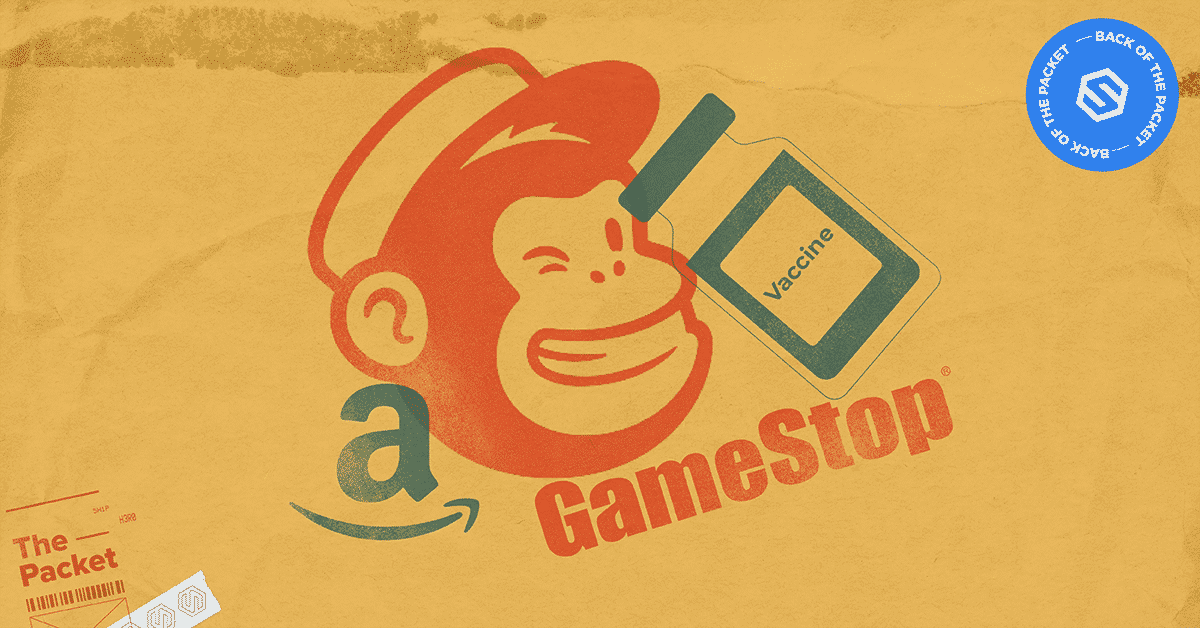
Websitechimp. The widely-used newsletter platform turned marketing company, MailChimp, has announced new services to further service their growing base of e-commerce companies and rival the likes of Shopify. Mailchimp’s new “Websites & Commerce” plans lets small and medium businesses launch online stores, as well as a new appointment booking service.
In Japan, dentists can now deliver the vaccine. That’s right, due to a lack of manpower for properly administering the vaccine to Japan’s population, there are 14 million unused doses of COVID-19 vaccines. As imports ramp up, the Japanese government faces increasing pressure to find ways of inoculating the general public. Up next, chiropractors?
This week, GameStop raised $551 million through an equity offering, sending its shares 15% higher in extended trading on Monday. This comes as Ryan Cohen, majority GME shareholder and owner of RC Ventuers, leads Gamestop through an e-commerce transformation to compete with other retailers in the video game space, like Walmart, Microsoft and Sony.
On Monday, Jeff Bezos’s rocket company Blue Origin filed a 50-page protest challenging a $2.9 billion NASA contract to SpaceX, to build a lander for American astronauts to return to the moon. In response to the protest, Musk’s tweet points to Bezos’s possible dysfunction.
Today’s customers prefer companies that offer overnight shipping and fast delivery times. Learn how to supercharge your supply chain and offer overnight shipping to your customers, in our blog post: How To Offer Overnight Shipping + Tips For Success.
What’s the difference between a 3PL and 4PL? If you don’t know, you could be missing some important information on your supply chain. Find out more about 3PLs, 4PLs, and e-commerce logistics in our recent post.
.svg)

The success of any business rests in the hands of the customer. If your customers aren’t happy, they won’t purchase your products or recommend your company. This leads to a reduction in sales that can ultimately drive your business into the ground.
There are many factors that come into play when dealing with customer satisfaction, but one of the biggest is the order fulfillment process. The speed and accuracy with which orders are fulfilled is one of the biggest determining factors in customer satisfaction, but it is also one of the most challenging aspects of running a business. To simplify and streamline this process for reduced costs and improved customer satisfaction, many businesses turn to 3PL providers and 4PL providers to improve their logistics strategy and expand their fulfillment capabilities.
In order to truly understand the difference between third and fourth-party logistics, you first need to understand the basics of how outsourced logistics works. Keep reading to find simple definitions of 1PL, 2PL, 3PL, and 4PL, followed by an in-depth look at the difference between third-party and fourth-party logistics.
An online retailer has a wide variety of options when it comes to fulfilling orders. Choosing the right logistics provider is the key to optimizing your supply chain and maximizing both profit and customer satisfaction. If you make the wrong choice, it could end up costing your company thousands, even millions, of dollars, not to mention end up hurting your customer satisfaction rating as well.
Before getting into the specifics of third-party versus fourth-party logistics, here’s a quick review of logistics terminology to put things in context:
In the above overview, the egg and farmer business is a hypothetical example that could be applied to any eCommerce business.
Every business has its own unique needs for supply chain logistics. For medium to large-sized businesses, however, it usually comes down to choosing between third-party and fourth-party logistics providers. Keep reading to learn the basics of both and to receive some tips for making the best choice for your company.
Simply put, a third-party logistics provider is a model that involves three separate parties. The first is the business itself, the second the logistics provider, and the third is the carrier. In this supply chain model, the business turns over logistics operations for inventory storage, packaging, and managing inventory as well as turning it over to the carrier for shipment. Another way to think of it is that a 3PL becomes the middleman between the business and the shipping carrier, taking care of the tedious aspects of shipping.
This supply chain model has been around since the 1970s, and the first 3PL providers were intermodal marketing companies that received packaged loads from shippers and transferred them to railroads. Today, the role of a 3PL provider has expanded to include services such as managing the movement of parts and materials from suppliers to manufacturers. It also includes transferring finished products from the manufacturer to the distributor or retailer.
In most cases, third-party logistics providers offer bundled supply chain services which may include some or all of the following:
These services can be scaled and customized according to the business’s needs. Generally speaking, businesses hire 3PLs when their supply chain becomes too complicated for internal management. For example, if a small business significantly expands their inventory as sales increase or grows through a merger or acquisition by another company.
If you’re still not sure whether a third-party logistics provider is right for your business, here are some examples of industries that can benefit from hiring 3PL providers:
Hiring third-party logistics companies could help you expedite your order fulfillment while also reducing costs and improving customer satisfaction. Before you commit, however, there is another option to consider – fourth-party logistics. Keep reading to learn more.
In a fourth-party logistics partnership, a business is basically outsourcing the entirety of their supply chain management to a logistics service provider. The 4PL oversees all of the different pieces of their client’s supply chain including warehouses, transportation companies, and agents. The goal is for the 4PL to be the single interface for the business between all aspects of the supply chain.
You can think of 4PLs as a supply chain integrator. It’s the most comprehensive supply chain solution available for a business. A 4PL is often a joint venture for enterprises that want business planning and project management to be handled by a separate entity. For example, companies like Deloitte and Accenture offer 4PL services to their clients.
In most cases, the 4PL does not actually own warehouse or transportation assets. Rather, it coordinates these services with vendors – it may also coordinate the activities of 3PL providers that are handling various aspects of the company’s supply chain. The difference is that 3PL providers are focused on day-to-day operations while 4PL providers focus on integration and optimization. A 4PL provider may also be known as a Lead Logistics Provider (LLP).
The primary benefit of hiring a 4PL organization is that the 4PL focuses on simplifying and streamlining logistics for the highest level of services for the best value. The 4PL becomes your single point of contact for the entire supply chain which is ideal for large businesses that have complex order fulfillment operations.
Here is a quick summary of some of the benefits a 4PL provides:
Now that you know a little more about what a 4PL does take a minute to review the potential pros and cons for hiring a 4PL provider.
If you’re still not sure whether a fourth-party logistics provider is right for your business, here are some examples of industries that can benefit from hiring 4PL providers:
In the industry of medical devices, surgeons often make last-minute orders and order multiple sizes of devices since they don’t know exactly what they’ll need. A 4PL provider is better equipped to manage complex chain-of-custody requirements and tight delivery schedules while reducing inventory costs.
Integrative technology enables a 4PL to optimize all aspects of the supply chain including determining the ideal parts, quantities, and locations based on anticipated demand. Field techs no longer have to double as warehouse operators and parts can be delivered in 30 minutes or less, improving efficiency and maximizing customer satisfaction.
By managing the entire supply chain network, 4PLs can allocate inventory to meet customer demand and to reduce missed opportunities. They also enable companies to provide same-day delivery regardless of location as well as same-day replenishment.
Now that you know the basics about third-party and fourth-party logistics, you may already have a sense for which one might be best for your company. Before making your choice, however, you should take a closer look at the unique differences between 3PL vs 4PL providers.
A 3PL is focused on the day-to-day operations of your supply chain logistics – it is more transaction-focused than a 4PL. That being said, a 4PL takes it a step further by optimizing your entire supply chain, including any 3PL providers your business might have hired. They take over the entire operation and become your single point of contact which leaves you free to pursue other things that might help grow and expand your business.
When an organization already has an effective, high-performance supply chain strategy in place, a 3PL provider can provide the extra support needed to execute that strategy efficiently. This type of relationship usually requires a significant degree of internal management to ensure that the 3PL’s performance meets business standards. While the day-to-day functions may be out of your hands, you still need to retain a certain degree of oversight. You should also keep in mind that because 3PLs are asset-based, some companies may be more concerned with utilizing their own assets than with providing competitive rates or more valuable services.
A fourth-party logistics provider is non-asset based which means that their focus is on finding the ideal combination of service and value. These providers utilize integrated technology to ensure a high level of visibility across the entire supply chain for both strategic and tactical analysis. Your business will still need to utilize some internal resources to oversee and manage 4PL performance, but it takes most of the weight off your shoulders when it comes to optimizing services and minimizing costs.
There are a lot of factors to consider when it comes to choosing between a 3PL and a 4PL, so be sure to do your research before you decide. Keep reading to receive some simple tips to employ as you start making your decision.
Know that you understand a little more about third-party and fourth-party logistics and how they differ, which option is best for your company? Unfortunately, there may not be a clear-cut answer. You’ll need to take a deeper look at your business operations to see where you are struggling and whether hiring a 3PL or 4PL provider might help.
Here are some of the signs that your company could benefit from hiring a 3PL provider:
For many businesses, hiring a 3PL provider is the first step as the business grows and expands. Over time, however, it might make more sense to move to a fourth-party logistics model. If your business has outgrown your in-house capacity for managing supply chain services and you want to optimize the entire process for efficiency and controlled costs, you may do best with a combination of 3PL and 4PL providers. The benefit of hiring a 4PL is, of course, that you can also gain the benefit of 3PL services without having to manage them yourself.
Whether you are hiring a 3PL or a 4PL provider, you need to do your research to ensure that you choose the company that is the best fit for your business. Take the time to delve deep into each company’s set of skills as well as their experience and reputation in the industry. You’ll be turning over a significant portion of your business’s essential operations, so you need to choose a provider you can trust 100%.
ShipHero is a leading 3PL service for ecommerce merchants. We handle logistics and fulfillment for over 4,000 online stores.
Due to our partnerships with major carriers, merchants working with ShipHero get reduced shipping costs for each order. Even better, our use of distributed fulfillment centers means you save even more money on transit costs and can get orders delivered faster.
With ShipHero’s distributed fulfillment network, orders can be delivered to most locations with 1 to 2 days. This allows you to offer the same delivery speeds that Amazon does, without having to let Amazon’s FBA fees reduce your profits.
We don’t just handle fulfillment for your Amazon orders. In addition to Amazon, ShipHero handles multi-channel fulfillment for Walmart, eBay, Shopify, BigCommerce, and most other eCommerce sales channels.
Every business is unique in terms of the services it provides, but all businesses have the same basic needs. Optimizing your supply chain process for reduced costs and improved customer satisfaction should always be a priority and hiring a 3PL or 4PL provider could be your next step to doing so.
Need a warehouse management system (WMS) for your 3PL? ShipHero’s 3PL services will help your eCommerce store run at full potential.
With online shopping becoming increasingly popular, providing customers with fast shipping options has become more crucial than ever. Leading eCommerce brands spend a great deal of time getting the specifics right for their shipments. With evolving technology and greater consumer expectations, overnight delivery has become an important service. While overnight delivery options are great for your customers, the idea of delivering orders in one day can be daunting for small eCommerce merchants.So, how does overnight shipping work, and what’s the easiest way to provide your customers with overnight deliveries? Let’s get to it.
Overnight shipping is the second quickest way of delivering products (after same-day delivery) where shippers guarantee that customers will receive their package on the next business day. One-day shipping, next morning, and next-day delivery can also refer to this process. Many popular carriers and shipping labels provide overnight shipping services; let’s take a look at them.
The United States Postal Service (USPS) is among the most popular delivery service providers in the U.S. The USPS Priority Mail Express Flat Rate is their fastest domestic mail service. It provides overnight to 2-day shipping with flat-rate pricing. USPS overnight shipping options come with tracking and insurance for most shipments. The price includes the proof of delivery signature record if the receipt is requested at the time of purchase. USPS is among the cheapest options because it operates through an extensive network of post office locations in the US. However, shipments to rural areas and Hawaii might be slightly delayed.
FedEx is a popular carrier in the United States, and it offers many overnight services and next-day delivery options. The delivery options depend on the service you choose. FedEx offers FedEx First Overnight Freight, FedEx Standard Overnight, and FedEx Priority Overnight shipping options. FedEx overnight costs are determined by the delivery time for the next day, the delivery address at the destination, the packaging size, and weight, etc.
UPS is another famous shipping label in the US. UPS offers three overnight shipping options within the US. These options are the UPS Next Day Air Early that is the fastest, UPS Next Day Air, and the UPS Next Day Air Saver that delivers the package by the next day evening. All of these options are trackable online, and you can visit the Tracking tab to do so.
DHL is among the most popular international shipping service providers worldwide. For emergency shipments, DHL offers the DHL SameDay Jetline option and the DHL SameDay Sprintline option. Despite being an exceptionally reliable option, DHL overnight international delivery is often expensive. There are daily cutoff times for this service for the next-day delivery options.
2-day delivery is already the standard for customer expectations due to the market dominance of Amazon Prime. Overnight shipping is becoming the name of the game and for the right reasons. As Amazon ramps up its investment in overnight and same-day delivery, customers are going to expect the brands they shop from start offering the same service.
In major markets across the spectrum, customers are demanding faster transit times and shipping speeds. When customers get speedier delivery options from platforms like Amazon, they expect the same from other brands.
Amazon Prime has taken the lead to set the example with its 2-day delivery options and even overnight shipping options. For customers, this has become the standard, and companies who want to compete with Amazon must offer the same to stand a chance. Otherwise, you’re likely to lose sales to Amazon and other major brands.
Because of the ongoing pandemic, shopping at brick-and-mortar stores has become an unsafe practice, and there are restrictions on in-person shopping. As such, more people are turning towards online shopping. As customers become more accustomed to online shopping, they’ll expect in-store pickup or fast delivery speeds for their orders.
Overnight shipping costs differ for different carriers with different shipping fees. They are usually determined by several factors, as listed below.
The package dimensions are used to calculate the dimensional weight of the package. This is done by multiplying the length, width or girth, and the height of the box. It is then divided by a DIM divisor to calculate the dimensional weight of the packaging.
In case the actual weight exceeds the dimensional weight, the former is used as the weight of the packaging to calculate the shipping costs. Carriers usually have a given rate for each lb. or Kg of the package weight.
Shipping zones operate on the distance between the point of origin, which is often the warehouse and the shoppers’ residences. Carriers define their shipping rates according to different shipping zones. Depending on where your warehouse is and where the package is headed, there might be some additional charges because of restrictions, resulting in an additional fee for shipping.
There is a way to lower shipping costs if you have made agreements with the shipping couriers. Most shipping carriers offer discounted rates for high shipping volumes.
While daunting, overnight shipping is indeed possible to pull off. You’ll have to research the most economical options for your business so that you don’t suffer a loss while offering overnight shipping. Here’s how you can do it.
Take a call with your carrier options and negotiate discounted shipping rates with them. You could base your argument that the more attractive your offer is for your customers, the more orders, and you will use more of the carrier’s services.
Realistic overnight delivery options can be pulled off by having your products stored in multiple warehouses near the areas where the bulk of your customer base lies (aka distributed fulfillment centers). This way, transit times can be reduced, and you can offer overnight shipping.
It’s costly to offer overnight shipping for small items and you can end up losing money on the sale. To tackle this situation, place a minimum order limit for your customers so that you can realistically cover overnight shipping costs. Customers can choose to get faster delivery speeds for an additional charge. You can also offer an Amazon Prime-like membership option where customers can get free or discounted shipping if they pay a monthly fee.
It can be difficult to guarantee overnight delivery and fulfillment, especially for small businesses. While big businesses such as Amazon store their products in multiple fulfillment centers, small businesses don’t have the luxury to store products in multiple warehouses across the world. Additionally, storing your products in warehouses can often be expensive and you might have to handle the fulfillment yourself.In case you are handling the fulfillment yourself through carriers, you might not be able to ship to rural and remote areas as handling these zones can be expensive. Furthermore, if your customer places the order on the weekend, like Friday, you might not be able to realistically deliver the shipment until the next working day, Monday. This brings a gap of two delivery days, Saturday and Sunday, and it might displease your customers. Realistically, overnight shipping can be expensive and time-consuming for small businesses to manage on their own. Luckily, eCommerce businesses can work with 3PLs that can help them provide faster shipping options.
By now, you understand the importance of overnight delivery options and how they can positively impact your business and sales. If you’re wondering how you can manage overnight shipping for your company, look no further for ShipHero has the solution to all your overnight shipping problems.
At ShipHero, there are no hidden fees. With ShipHero, you can look for the cheapest options to minimize your total fee. Our single shipping rate and discounts make overnight shipping manageable for businesses of all sizes.
ShipHero handles your order fulfillment by distributing the products across the nationwide network of fulfillment warehouses. This way, transit delays are minimized, and your customers get their orders on their doorstep faster. This is the reason ShipHero lets you offer overnight and 2-day shipping to your customers without any worry or hassle.
ShipHero integrates seamlessly to your existing online shops on Shopify, Etsy, WooCommerce, Amazon, Quickly, and more, to provide you with the best experience possible. You can efficiently manage your products and customer orders from a single dashboard with ShipHero.
Overnight shipping is an excellent service to offer customers, but you need to make sure that your brand can offer it without wrecking your profits. If overnight delivery is something you're prepared to offer, then you need the right automation and tools to help you seamlessly manage your operations. ShipHero handles your fulfillment effortlessly and keeps your customers coming back for more. Get started with ShipHero today.
The Beauty industry, as well as the fashion & apparel industry, were amongst the hardest hit sectors during the pandemic. Due to the fact that these industries rely on in-person brick-and-mortar shopping to browse their high number of SKUs, find the right fit, and test product quality, the beauty industry has struggled to adjust to the digital shopping experience. Until now.
While traditionally relying on in-person samples and consultations, Estée Lauder Co. (ELC) has begun to rethink digital shopping. This week, Clinique (an ELC brand) quietly launched a new site in the UK, which features video chat consultations, product demos using augmented reality, the ability to shop based on product preferences, skin types and recommendations based on user data. Soon, they will roll out a feature for friends to shop together online from various locations, customize their own storefronts and control their digital shopping journey from end-to-end.
Nicky De Simone, enterprise marketing and transformation at Estée Lauder Companies, says “One of the things shoppers love about going to the store is that social connectivity. As much as we have pivoted digitally, we were still losing the customer along the way. [We] will leverage data to route a consumer’s consultation through to the right consultant for them and who will be able to make smarter recommendations.”
Personalization has been a major e-commerce trend for many industries (think: supplements), due to the widespread ability to collect personal information and deliver services and recommendations based on consumer preferences. Beyond big data, other emerging technologies like augmented reality, virtual reality, chatbots and personal assistants are creating new avenues for brands to engage with their customers at scale. Companies like L’Oreal have made big investments when it comes to digitizing their shopping experience.
No.
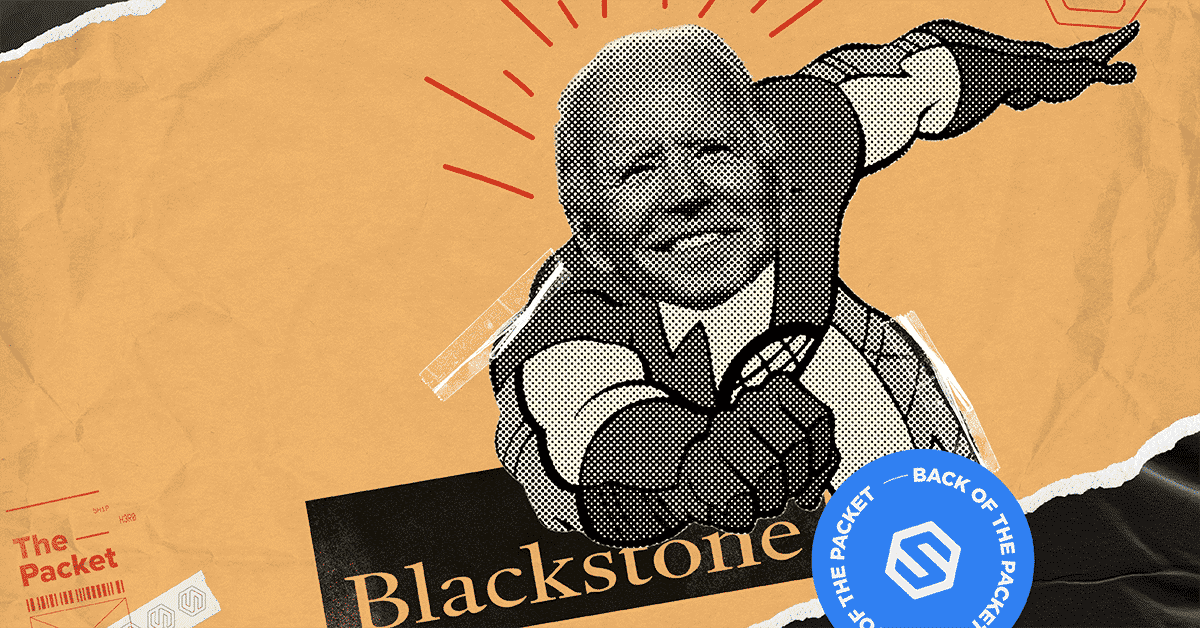
Already the largest owner of office buildings in India, Blackstone Group Inc., has now publicized plans to become the country’s largest owner of warehouses, as well. While e-commerce continues to rise in India, the investment firm plans to spend $720 million to purchase 3.5 million square feet of industrial warehouses, as well as 18 million square feet of development sites that could be used for fulfillment and logistics properties.
Before hosting the upcoming global climate summit (which falls on Earth Day) with world leaders from China, India, and more, President Joe Biden pledges to reduce U.S. greenhouse gas emissions by at least 50% by 2030, more than doubling the previous agreement under the 2015 Paris Climate Accord. in the latest push by the administration to aggressively combat climate change. This pledge comes after more than 300 businesses called on President Joe Biden earlier this month to readjust their gas emission targets.
Gym bros, swoll-mates, keto cadets, dieteers ‘til you die … no matter what you call it, weight loss and fitness is a lot more fun and successful when you have a trusted companion. That’s exactly how this eCommerce CEO’s voyage started -- while embarking on his own health journey, Alex Brecher, CEO of BariatricPal, recognized the need for support, connection, and community, and launched the BariatricPal store to provide the bariatric community with high-quality food, snacks, vitamins and health accessories. Learn more about Alex’s journey in our latest case study.
What is Fulfillment-by-Amazon (FBA) & Fulfillment-by-Merchant (FBM)? What are the pros/cons of each? How do they compare/contrast and which one right for my business, if any? Let’s dive in.
The secret to success with any ecommerce business is to keep your customers happy. Rapid order fulfillment, free shipping, and excellent customer service are some of the best ways to do that. When determining an ecommerce business plan, many fail to factor in (or underestimate) product returns.
Returns are a necessary evil for any ecommerce business, and if you don’t handle them properly, they could swiftly break you. Frequent returns negatively impact your profit margins but also destroy conversion rates, bring down customer loyalty,, and threaten the survival of your business as a whole. Developing and enforcing a strong returns policy is a must if you want your business to be successful. Counteracting return fraud should also be a focus to further prevent lost profits.
In this article, we’ll cover the ways in which your return policy impacts sales and how to change your policy to benefit your business. We’ll also cover some of the best ecommerce return practices to make sure that returns don’t ruin your business.
In 2017, there were over 1.6 billion digital buyers around the globe – that’s more than 20% of the world’s population. What’s more is that number is projected to increase to over 2.1 billion by 2021. Though the e-commerce market presents nearly limitless possibilities for retail businesses, it does come with its challenges.
Reaching your target audience can be tricky when you have billions of potential customers, and you must compete with dozens or even hundreds of businesses like yours. In the wide world of ecommerce, it’s the little things that make your business stand out – things like your return policy and refund policy.
According to Star Business Journal, returns at brick-and-mortar stores hover around 8% to 10% while returns for online retailers are nearly double at 20%. Furthermore, returns can be extremely expensive for a business – particularly during the holidays. Here are some eye-opening statistics:
To account for the logistics of returns, many businesses take steps such as increasing their workforce, adding more warehouse space, and creating separate departments to handle returns. All of these factor into an ever-dwindling profit margin as the cost of returns grows higher.
Before getting into the details of how you can keep ecommerce returns from potentially ruining your business, let’s take a closer look at some of the ways returns affect your overall profitability.
To a certain degree, keeping your customers happy is about transparency. Customer expectations in the world of online shopping are high considering they can switch to a competitor’s site or Amazon in just a few seconds.
The customer experience in today’s world is critical to success. Your customers want to know that the products they are purchasing are of the highest quality and they are getting the best value for their money. Customers want to know their order will be processed quickly and efficiently and that they can contact customer service with questions or concerns, which will be resolved in a timely manner. They also want to know what your return policy is upfront, before clicking “buy”.
Your ecommerce return policy affects your business more than you may realize. According to recent research, about 67% of online shoppers will check a company’s return policy before buying. What do customers like and dislike about return policies? Let’s take a look…
As an ecommerce business owner, you need to account for all variables when it comes to profitability. While it might cost your company money to offer free returns, doing so could, in turn, boost your sales. In fact, customers are twice as likely to make a large purchase (over $1,000) online if free returns are offered.
To give you an example of what a good return policy can do for your business, consider the Zappos model. They were the first ecommerce retailer to offer a 365-day, free two-way shipping, and returns policy. What’s more, is that the free return shipping policy allowed customers to return their shoes for any reason. This was absolutely unheard of in 1999.
According to Zappos’ VP of Services and Operations, the company’s best customers have the highest return rates (up to 50% of everything they purchase) but they also spend the most money which makes them the company’s most profitable customers. At first glance, it may sound like their return policy is hurting business but, over time, those loyal customers end up spending more, which offsets their returns.
Simply put, a lenient return policy (when properly executed) can make a huge difference for your business and for your profit margins by creating a more loyal customer base.
In order to improve your returns policy, you first need to gain a better understanding of who is returning your goods and why. Here are some of the most common reasons for returns:
In addition to identifying why certain items are being returned, it is also helpful to develop customer profiles to determine who is making the most returns and how to prevent it from damaging your business. For example, some customers intentionally take advantage of lenient returns policies by purchasing items to wear once and have no intention of keeping them after. There are also others who order multiple sizes and options for the sole purpose of trying them on at home.
Having developed a better understanding of your customer base and the most common reasons for returns, you can now work on developing a stronger return policy.
Now that you understand that the majority of customers will check a company’s return policy before making a purchase. It is also important to note that nearly 50% of customers will continue buying from a company if they have a hassle-free return policy. So, how do you create a return policy that improves your profit margins while also retaining your customers?
Here are some simple tips to help you develop a strong return policy that wins over customers while keeping return rates low:
Your customers want to know that if they aren’t satisfied, they’ll be able to return the item easily. For example, if you sell footwear, your return policy can state that all shoes can be returned within 30 days if they’re still in good condition.
A clear return policy makes it easy for customers to understand which products can be returned and which can’t. If you have products that have a separate return policy, be sure to list them on the product page so customers are aware of any special return policies.
Your customer shouldn’t have to search for it. A strong return policy should show that you stand behind your product to instill confidence in your business to build trust with the consumer.
You should personalize your return policy to your business and products. While there are templates available to help you craft a return policy, they’re meant to be customized to your brand’s unique return policy.
Avoid phrases like “you must” and “you are required to.” You want your returns process to be easy, not scary.
Some customers expect immediate refunds or a gift card when returning a product. Your return policy should list out the steps involved during the return process so they know how it all works.Make it clear whether you offer an exchange for returned products or if you provide store credit or a full refund.
The bane of any online retailer’s return policy is deciding between full refunds or store credit. While there is no one clear answer as to which one to choose, we recommend surveying your customers to see what they’d prefer.
Tell the customer whether they need to use the original packaging or if they can use their own. Tell them if they need to include the order slip and if they can print a return label online.
So they understand the return policy and can communicate it to your customers quickly and efficiently. If your staff is confused about the returns policy, it could lead to negative interactions with customers when they try to return products.
No company is perfect but having a strong returns policy will prevent returns from destroying your business. Even with a strong policy, however, you should be prepared to take a hit now and again. If you make a mistake with shipping or packaging, you may be forced to eat the cost yourself for the sake of keeping your customer happy. Unlike physical stores, customers can’t just walk in and return a product at no cost to you. Always keep the customer and your long-term bottom line in mind.
The term reverse logistics is sometimes used interchangeably with returns, but they are not quite the same. Technically speaking, reverse logistics refers to monitoring the life-cycle of a product after it arrives at the customer’s door. This includes the ways the product can be reused, how it should be disposed of, and other ways to create value with an expired product – it also involves the return of products from the end consumer back to the manufacturer.
In order to develop a reverse logistics procedure, you need to first think about the different stages a product goes through during a return. First, you’ll need to consider the physical shipping of the returned product – how you will get it from the customer back to the warehouse. Next, you may need to test the returned item to identify existing flaws and document any problems. Then, you’ll need to repair, recycle, or restock the item.
To help you get a better understanding of the reverse logistics portion of your company’s supply chain, there are four key analytics to consider:
Once you’ve gathered this information, you can gain a deeper understanding of your company’s reverse logistics and use that information to optimize your workflow. Improving the efficiency of your reverse logistics system provides numerous benefits, including the following:
When you plan ahead for returns and implement a system to ensure that orders are fulfilled correctly, you can minimize related costs for administration, shipping, quality assurance, tech support, etc.
By implementing a reverse logistics system, you can increase the speed with which orders and returns are processed which keeps your customers happy.
A poor return policy can prevent a customer from coming back, but a strong policy instills confidence in the brand and makes customers more likely to purchase again, even after you’ve made a mistake.
By using a reverse logistics system to gather data on returns, sellers can decide how best to use returned products to reduce losses. You could fix and restock the product, scrap it for parts, or repurpose it in another market.
ShipHero is a leading 3PL for ecommerce merchants. We work with over 4,000 ecommerce merchants to ship out millions of orders a year and process returns as they come in. Here’s why you should let ShipHero handle fulfillment and logistics for you.
Don’t want to handle every return that comes in? Leave it to us. With ShipHero, we handle all returns as they come in. With our integrations with your ecommerce platform and marketplaces, returns are easily processed on our end.
ShipHero currently integrates with Returnly to make returns management even easier. With our open API, ShipHero can be connected to any of your returns software to make the returns process easier to integrate into our workflows.
With ShipHero, you’re able to offer customers 2-day and overnight delivery as shipping options. These can be powerful conversion drivers that help you compete against the likes of Amazon and other major brands so you stop losing sales to them.
Handling returns in a quick and efficient manner is the key to keeping your customers happy. With a strong returns policy, you can minimize the damage caused by shipping errors, manufacturing defects, and other issues that necessitate a customer return. When your customers feel like they can trust your company to correct errors in a timely manner, they will be more likely to become repeat customers.
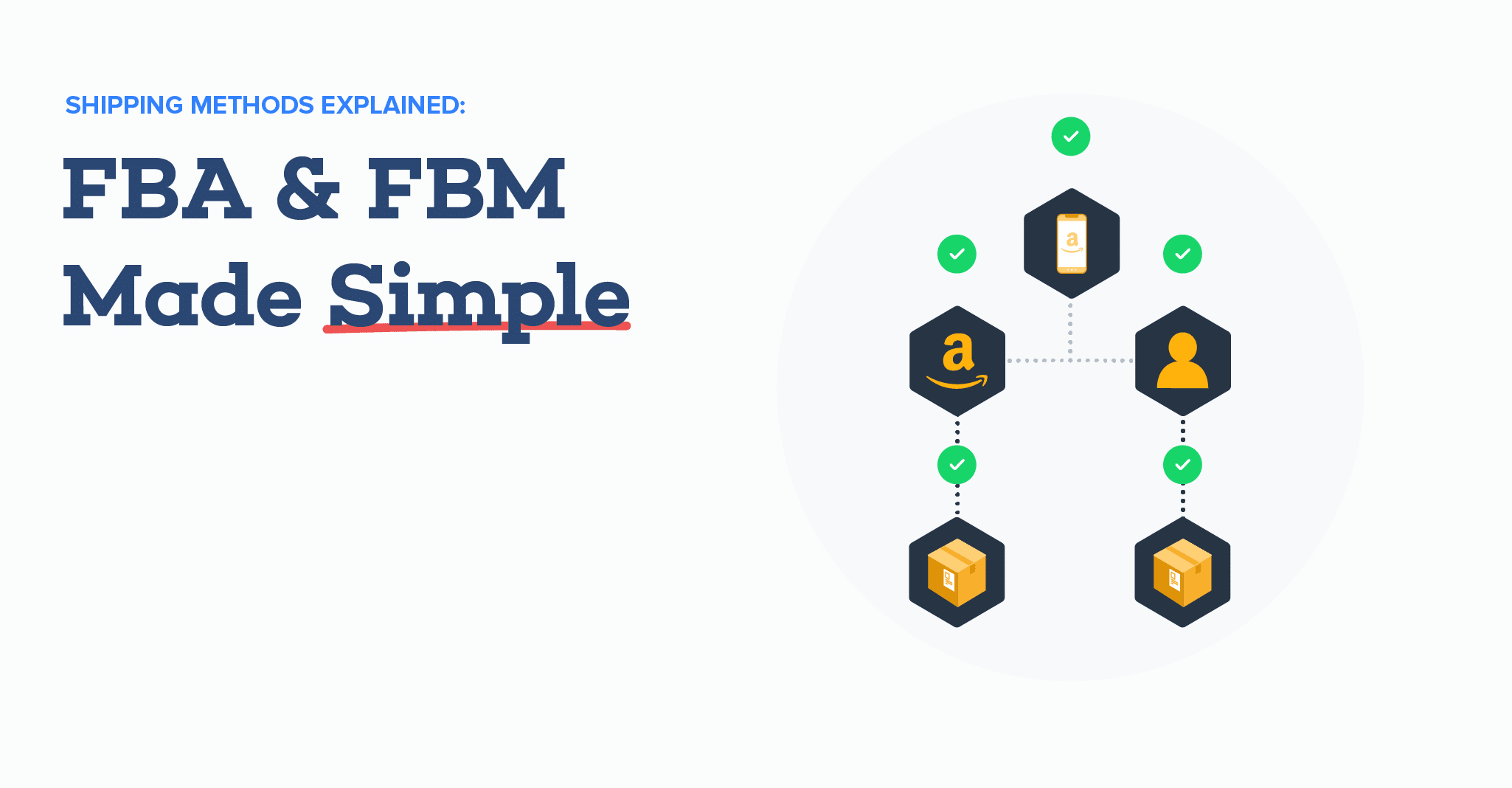
Between finding the best deals, navigating carrier requirements and managing inventory, order fulfillment is challenging and time-consuming. Fortunately, you can outsource order fulfillment to third parties to focus on other business tasks.
Amazon offers two fulfillment methods for its sellers: Fulfillment by Amazon (FBA) and Fulfillment by Merchant (FBM). What are the differences, and which one should you choose? Read on to find out!
FBA is a fulfillment option where Amazon handles all order fulfillment tasks for sellers. If you register for FBA, your inventory is stored in a designated Amazon warehouse so the fulfillment crew can pack and ship your items.
Meanwhile, FBM involves a company selling its product on Amazon sales channels while handling storage, shipping and customer support on its own.
Of all current Amazon sellers:
FBA and FBM sellers can ship products via Prime, Amazon's reward program that offers one or free two-day shipping. Amazon reports that sellers with Prime memberships are more popular than non-member sellers – customers are more likely to purchase products from you if the Amazon
Prime badge shows up on your listings because customers want fast deliveries.Prime is automatically available for all FBA sellers. If you’re an FBM seller, you need to earn a Prime membership by joining Seller Fulfilled Prime (SFP). To be eligible for and retain a Prime membership, you need to ship all of your orders on time and have a low cancellation rate – otherwise, you’ll lose it.
Seller Fulfilled Prime is currently not accepting new registrations, but you can sign up for the waitlist.
Fulfillment by Amazon sends your products from an Amazon warehouse directly to customers. Here’s a simple guide to explain how FBA works:
Considering your specific business and the products you sell, you may be better off with FBA, FBM, or a hybrid of the two. Each option is evaluated below on the cost & fees, autonomy & control and ease of use.
FBM is the better option for your company if:
FBA is better for your company if:
One of the best perks of being an Amazon FBA member is that Amazon handles your entire inventory process. All you need to do is ship your products to an Amazon FBA warehouse, and the team there will do the rest.
Recently, Amazon introduced a “Send to Amazon” inventory replenishment method that’s very simple and saves you a lot of time. Here’s how to send items to an Amazon FBA warehouse:
First, choose what items you plan to send to an FBA warehouse from your product listing and enter how many units you're sending.
Input your destination Amazon FBA warehouse, then choose between an Amazon-partnered carrier or your preferred carrier company.
Depending on your choice in the previous step, you can print shipping labels directly from the Amazon Shipping Services page or your chosen carrier's company website.
Once you have printed labels, attach them to your product boxes. Note that Amazon has strict packaging requirements, so make sure you use the right boxes.
With the labels attached, you can schedule a courier pickup or visit the nearest office. From there, the carrier will ship your items to an Amazon FBA warehouse, where an inventory team will handle the rest.
You'll be charged costs and fees if you participate in Amazon FBA. Here are some factors that influence your Amazon FBA usage costs:
You can use Amazon's FBA Calculator to predict fees and expenses, given your item sizes and weight. Overall, the fee structure for FBA sellers dramatically increases with the size and weight of a product; therefore, FBA sellers with small, lightweight products incur fewer fees.
Inventory turnover is the speed at which a company sells and restocks inventory. Amazon tracks sellers' inventory turnover and assesses fees based on the duration; in other words, sellers with products that sit in Amazon fulfillment centers for longer (i.e., have slow turnover rates) must pay higher FBA fees. Additionally, if a product sits in an Amazon fulfillment center longer than 365 days, they are charged long-term storage fees.
All FBA sellers must pay FMA fees to cover the shipping and handling costs involved with fulfilling their company's orders. These most likely cover the labor hours, packaging and overhead that Amazon incurs to provide this service.
FBA and FBM have their pros and cons. To help you choose, we’ve laid out some key differences between the two fulfillment methods below:
How much control do you hope to retain over your company? FBM has the most power and autonomy regarding fulfillment because there are many ways to fulfill your product, like dropshipping, outsourcing to a 3PL, leasing and operating your warehouse, or even using a spare bedroom in your apartment for storage.
Meanwhile, FBA sellers have little to no autonomy over handling their products. Once you ship products to the FBA warehouse, Amazon will handle the entire order fulfillment process.
Most FBA members pass customer service responsibilities off to Amazon, so they don't usually speak directly to customers. Outsourcing customer service means saving money and effort because you don't have to pay or train customer service specialists. However, you're also passing up a chance to communicate directly with customers and foster brand loyalty.
Meanwhile, Amazon FBM sellers are 100% responsible for customer service. Because the customer service ball is in your court, you must spend time and money to ensure a positive customer experience. However, this is an opportunity to connect with customers and reinforce your brand.
FBA sellers have little concern over their seller feedback and rating because Amazon handles most of the process. In fact, FBA sellers can request Amazon to remove negative feedback if Amazon was the one who handled the fulfillment.
FBM sellers have almost complete control over their sales, so you might be easier targets for bad feedback. Since you can't request Amazon to remove negative feedback, you must constantly deliver the best service and respond to negative reviews on your own.
The whole process of order fulfillment, picking, packing and shipping is laborious and time-consuming.
For companies and brands with no sales channels or fulfillment methods, Amazon FBA allows instantaneous access to a gigantic logistics network for a price. But this also saves you time to focus on the aspects of your business that need your attention most.
Companies and brands that already have fulfillment channels and are considering adding Amazon should consider whether the additional FBA logistics channel is worth the costs, especially those that sell big, heavy products.
If you already have logistics channels and partners, FBM is likely the better option because you don't have to pay the extra FBA fulfillment costs.
Which one is “best” between FBA and FBM depends on what you want out of your business. There's no doubt Amazon will remain the #1 eCommerce site for a long time, so both options are relatively stable.
Generally, FBM is better if you want more control over your sales process and build more brand loyalty through direct customer interactions. FBA is better if you want a hands-off approach to order fulfillment and are fine with Amazon running your customer service.
Even if you're an FBA member, shipping items to Amazon warehouses takes time and effort. Fortunately, you can go to freight forwarders to help send products out to Amazon FBA without hassle. Here are some of the best Amazon FBA freight forwarders operating today:
Unicargo is an Amazon freight forwarder that inspects your products upon picking them up, so you don't accidentally ship damaged goods to the FBA warehouse. Unicargo also offers short-term storage warehouses if something happens with your FBA membership.
Flexport offers freight forwarding services with real-time tracking in over 80 countries. If you run an environmentally-aware business, Flexport is a good choice because one of its mission to attain 100% carbon neutrality.
Freightos helps you compare freight quotes from dozens of providers so you can find the best deals easily. It also offers on-demand freight tracking and issue resolution assistance if things go wrong mid-shipment.
Need help with fulfillment for your Amazon orders? Here's how ShipHero’s third-party logistics software can help you offer Amazon-like delivery speeds without breaking the bank.
ShipHero has fulfillment centers across the country that deliver to customers within one to two business days. We can help you deliver as fast as Amazon – without the FBA fees.
ShipHero doesn’t just handle Amazon order fulfillment. We offer third-party order fulfillment for numerous major eCommerce platforms like eBay, Shopify, Walmart and BigCommerce.
Thanks to ShipHero’s partnerships with multiple shipping carriers, Amazon sellers working with us get lower delivery costs for each order. Moreover, our fulfillment network makes last-mile delivery faster and more affordable.
So, is FBA or FBM right for your business? Stay tuned to our Shipping Methods Explained series as we dive deep into the specifics of fulfillment.
Learn more about ShipHero's industry-leading warehouse management software.
You can use both FBA and FBM. In fact, about 34% of Amazon sellers use both fulfillment methods. You can use FBM to sell large products that don’t sell too well and FBA to sell smaller, high-selling products. This combination method saves you more money because you can avoid large item fulfillment and long-term storage costs.
Amazon doesn’t charge subscription fees if you’re an individual FBM seller, but you’ll be charged $0.99 for every product sold. However, you can get a Pro FBM subscription at $39.99/month to avoid paying $0.99 for every item you sell.
Amazon takes a variable FBA fee, depending on the product’s size and dimensions, that starts at $2.92 for every item sold. You also need to pay monthly storage fees based on how much merchandise you have in FBA warehouses.
-
About ShipHero: We make it simple for you to deliver your eCommerce. Our software helps you run your warehouse, and our outsourced shipping solutions eliminate the hassle of getting your products to your customers. With over 5,000 brands and 3PLs relying on us daily, we’re here to help with all your logistics needs.

Fulfillment centers, also known as 3PLs, provide a great option to expand your fulfillment capabilities. ShipHero Fulfillment provides an easy outsourced fulfillment option without the need to engage with a 3PL directly if you're running a Shopify store and are looking for simple fulfillment services.Online shopping has made it easier than ever for consumers to find the products they want at the best price. As brick-and-mortar stores slowly fade into the background, eCommerce stores are taking advantage of nearly limitless scalability and a worldwide customer base.Though the convenience of online shopping is a major draw for many consumers, a positive customer experience is still vital for success. If purchases take too long to process or if shipments are delayed, your business could suffer and you may lose potential repeat customers. Rather than limiting your inventory to prevent backups and shipping mishaps, consider using a fulfillment center to manage your store’s inventory. These companies help your business deliver global eCommerce order fulfillment.Fulfillment centers, also known as third-party logistics companies (3PLs), provide a great option to expand your fulfillment capabilities. If you’re an eCommerce merchant selling products on Amazon or another eCommerce platform, a fulfillment center handles all the order processing for you. They’ll receive the order, prepare it for shipping and get the order delivered to the customer. ShipHero Fulfillment provides an easy outsourced fulfillment solution for many eCommerce merchants running on a variety of marketplaces including Shopify, WooCommerce and more. In this article, we’ll explore fulfillment centers as a convenient option for online merchants. You’ll learn what a fulfillment center is, how it compares to warehousing and the specific benefits of using a fulfillment center. We’ll also provide helpful tips for choosing the right fulfillment center for your business. Another option if you’re looking to outsource your shipping is to use a fulfillment service, a new option for using a fulfillment platform to manage and ship your orders without engaging with a fulfillment center directly. We’ll add an article that details more about this and how you could use Shopify store fulfillment.
A fulfillment center is a location, typically a large building, that fulfills eCommerce retail orders. A fulfillment center handles the entire order process, from picking and packing to shipping. Without a fulfillment center, an eCommerce retailer must take items from their inventory, pack them and send them through a shipping carrier to the customer. If you run an especially popular business, you may be swamped with orders and spend most of your valuable time processing shipments instead of developing your business.Not just that, but more orders mean a larger chance of human error in the shipping process. If your team loses focus because they’re overwhelmed, they may make mistakes that result in unhappy customers. To prevent errors and save valuable resources, third-party logistics companies often offer fulfillment center access to their clients.
Three main types of fulfillment centers serve different purposes and cater to varying business models:
The global e-commerce fulfillment market is expected to grow from $141.35 billion in 2025 to $468.44 billion by 2034, so having the right type of fulfillment center is more important than ever to stay competitive and meet evolving customer expectations.
Fulfillment centers work by storing your inventory so your 3PL’s team can process orders whenever they come in. Here’s a quick overview of how fulfillment centers process your orders:
The general process is similar to doing it yourself, but fulfillment centers do it at a larger scale to take the burden off your hands. Fulfillment centers are generally more experienced in fulfilling orders, so they can do it more efficiently.Fulfillment centers can process business-to-business (B2B) and business-to-customer (B2C) orders cost-effectively. B2B orders are usually shipped to the client’s shop or storage, while B2C orders are shipped to the customer’s residence.
Online stores provide customers access to a wide range of products they might not have access to in traditional brick-and-mortar stores, depending on their location. By shopping online, consumers also can compare prices. However, online shopping is about more than just finding the best price; it's also about efficient shipping and an overall positive customer experience.On the seller’s side, online shopping opens up a whole new customer base that isn’t limited to a specific region. Though this creates the potential for much higher sales margins, it does come with a few challenges. Overselling, for example, is a common problem among online merchants. This happens when the merchant receives more orders for an item than they have the inventory to fulfill. They are then forced to contact their customers to tell them that the item is out of stock or shipping will be delayed. Both options can lead to low customer satisfaction levels and potential lost sales.All it takes is one angry customer to write a bad review that could dissuade other customers from buying your products.In addition to overselling, many online merchants encounter specific shipping issues such as mispicks and misships. A mispick happens when the merchant selects the wrong product for an order, and a misship occurs when the wrong item is sent to the customer. Both of these situations result in returns. Plus, there's a high probability that the customer will simply cancel the order instead of waiting for the correct item to be sent.The larger an online business's inventory, the higher the risk for problems. It might be time to consider a fulfillment center if you're currently trying to manage your inventory directly and experiencing these and other issues.
The term fulfillment center is often used interchangeably with warehouse, but the fact is that they are different. Both are large buildings used to hold business inventory, but the services offered can differ.A warehouse is a long-term storage solution used to store products for an extended period. In many cases, a warehouse is an industrial space designed to house inventory items in bulk. If you were to walk into an inventory warehouse, you'd see products being moved by a forklift on large pallets stacked high with large quantities of similar products. Warehouses are primarily used by wholesalers and businesses that fulfill B2B orders.Generally speaking, a warehouse is usually the best option for retailers that have a diverse inventory and stock large quantities of products. Large retailers sometimes have the capital to purchase warehouse space, but leasing is usually the most cost-effective option for small and mid-sized retailers. For small businesses, renting a storage unit is sometimes the best option.A fulfillment center performs some of the same roles as a warehouse but with additional services. In addition to storing inventory, a fulfillment center will fulfill customer orders. When an order is placed through an eCommerce store, the order is forwarded to the fulfillment center, where the inventory is picked and boxed up, then labeled for shipment and sent to the customer.Using a fulfillment company means outsourcing order processing which takes the burden off your shoulders and lets you focus on other areas of your business.
Despite their surface similarities, fulfillment centers and warehouses offer different services. Here’s a look at three elements that set fulfillment centers apart from warehouses.
Warehouses are designed for long-term storage, where your items are kept for months or even years. Meanwhile, eCommerce fulfillment centers are more common for short-term storage because your inventory frequently changes as orders come in and out. In fact, your inventory shouldn't stay in fulfillment centers for a long time because storage fees can get expensive. At the same time, you should keep sending inventory to fulfillment centers to avoid running out of stock.
Warehousing operations are generally very simple. Items come in when you send them and come out when you need them. There's not a lot of processing involved aside from moving items around.Meanwhile, fulfillment centers have more complex operations because they handle order processing. Here are some key operations of a fulfillment center:
Warehouses don’t see a lot of shipping company pickups because you can get items shipped in bulk instead of individually. That’s why we typically see scheduled truck pickups at warehouses, with items being stacked together in big batches with pallets.Fulfillment centers often see daily shipping company pickups or even several times a day if you run an especially prolific eCommerce business. eCommerce fulfillment centers get multiple shipper pickups daily because they need to fulfill customer orders that come in even after business hours.
Here is a quick summary of the differences between a warehouse and a fulfillment center:
Every 3PL provider is different regarding their services and the size and type of businesses they cater to.Later in this article, we'll talk about how to choose the right fulfillment center for your business, but for now, let's take a closer look at the benefits fulfillment centers provide.
Simply put, the benefit of using a fulfillment center instead of directly managing your inventory is that you don't have to deal with the inventory management's ins and outs (e.g., storing, shipping and returns). It may sound simple, but you will never go back once you make the switch. The supply chain for eCommerce companies is complicated, and fulfillment centers make the supply chain easier to manage.After using a fulfillment center to manage your inventory, you’ll find that the order fulfillment process not only goes much smoother, but you’ll be able to free up time on your end which can be dedicated to growing the business (rather than managing it).Here are some of the top benefits of using a fulfillment center:
Working with a fulfillment center means you don't have to find extra space for your inventory on your premises. This is especially useful if you run a small business at home or in a small office.
Fulfillment centers handle everything from product picking to shipping, so you don't have to do it yourself.
Many fulfillment centers work with shipping carriers to give you delivery cost savings. Lower shipping rates mean you save money with each sale, growing your profit.
Working with fulfillment centers allows you to offer 2-day or overnight shipping options to your customers.
Fulfillment center workers know what they're doing, so you can trust your items will be properly organized and stored. You also get live updates to see which items are in and out of stock.
Your fulfillment center assists with returns and exchanges, saving you a lot of time and effort.
Fulfillment centers and 3PLs handle inventory and order fulfillment, so you don't have to. This means you can focus on other tasks for your company, like marketing, customer service and product development.By now you should have a thorough understanding of what a fulfillment center is and how it can benefit your business. If you’re ready to make the switch, you’ll be glad to know that there are 3PL providers all over the country waiting to handle your inventory. Keep reading to learn how to find them.
A fulfillment center may seem like the perfect solution if you've been struggling to keep up with orders and manage your own inventory. While 3PL providers can take the burden of order fulfillment off your shoulders, there are some things you need to consider before you commit.First and foremost, you need to determine whether it's a cost-effective solution to start using a fulfillment center. Prices vary from provider to provider but will include costs for things like warehouse space, equipment, warehouse management, staff salaries, worker's compensation and liability insurance, packaging supplies, postage and more. Some 3PL providers offer a flat rate while others add individual fees per task, such as picking and packing.In many cases, outsourcing your order fulfillment services costs more than doing the work yourself, but what you'll be saving is time. If managing your inventory and fulfilling orders is holding you back from doing the work you need to grow your business, outsourcing may be worth the extra cost.Not only do you need to consider the cost of using a fulfillment center, but you need to make sure that the center you choose is compatible with your eCommerce platform. The type of software you use determines whether the 3PL provider will be able to receive, process and track orders. The easiest option is to choose a provider that can integrate with your existing software rather than changing your entire eCommerce platform to match the provider.With these factors in mind, here is a simple process to follow when choosing a 3PL provider:
Sit down and take a closer look at your inventory as well as your shipping process. Take the time to identify existing problems and consider whether a 3PL provider could resolve them.
You may be able to find a 3PL provider in your region, or you could choose one closer to your largest customer base.
Each 3PL provider is different, so you'll need to know your business's needs before finding a company to match.
Once you've created a list of options, narrow it down to the top three choices – these are the companies you'll evaluate on a deeper level to make your decision. Any more than three will simply be too much to handle.
You'll be relying on your chosen 3PL provider to fulfill your customer's orders and handle returns efficiently. Choosing a company with similar culture and values to your own is important for maintaining a consistent and satisfactory customer experience.
Even if your business is still fairly new, you already have some kind of management software in place – save yourself the hassle of switching by choosing a 3PL provider that is compatible with your existing management software.
Ideally, outsourcing your order fulfillment process will give you more time to focus on what it takes to grow your business. Choose a 3PL provider that can scale its operations to accommodate your changing business needs.
Depending on what your business sells, you're likely to have customers from all over the country. You want to choose a 3PL provider with multiple distribution center locations to keep costs down and optimize your efficiency.
Though the satisfaction of your own customers is paramount, you also want to be satisfied with your 3PL experience. Look for a company with a proven track record that you can trust to handle your business's day-to-day order fulfillment operations. Financial stability is also an important consideration, and you should look for a provider with plenty of industry references – and don't hesitate to check them!
Each 3PL provider prices their services differently, some according to the size of your business and others by individual services. You'll need to sit down with your chosen provider to determine the exact pricing and what specific services are included.Once you've chosen a 3PL provider, you need to sit with them and discuss the details. Many small businesses who switch to using a fulfillment center skip this step and end up frustrated when there is no clear process.Before you sign a contract, sit down and go over the details of exactly what you expect from the company and how they will fulfill those expectations. You'll need to determine which responsibilities the 3PL will handle and which you will retain in-house. It's also a good idea to establish a schedule for regular meetings between members of your team and representatives from the 3PL. This is where you'll evaluate the 3PL's performance and discuss any changes that need to be made.
Looking for a great fulfillment center provider for your eCommerce business? Here are three example fulfillment companies to consider:
Fulfillment by Amazon (FBA) boasts over 170 fulfillment centers and 150 million square feet of storage space. Additionally, FBA users can offer free two-day delivery to their Amazon Prime shoppers – a great way to draw customers in and improve sales.In addition to Amazon itself, FBA also supports numerous eCommerce platforms like Shopify and WooCommerce.
Shipping carrier FedEx offers a full-service fulfillment center and third-party logistic service that includes packaging, warehousing and order fulfillment. In addition to its complete suite of services, FedEx Fulfillment also assigns small business owners a professional assistant to teach them about fulfilling orders.
Rakuten Super Logistics boasts 100% order accuracy and guarantees order turnaround by the next business day. Rakuten Super Logistics users can also offer customers two-day ground shipping to 98% of the United States.However, Rakuten Super Logistics requires a minimum volume of 250 orders per month, so it may not be the best option if you can’t pass the threshold consistently.
Boasting over 4,000 eCommerce partners, ShipHero is one of the leading 3PL companies for online merchants. Here are some key benefits of working with us as your third-party logistics provider:
You may have lost sales because your store doesn’t offer 2-day delivery like Amazon. Customers expect 2-day shipping everywhere they shop, but building a fulfillment network that can do that is a lot of work for a business – especially a small one.If you work with ShipHero, you can offer 2-day and overnight delivery to compete with Amazon and other eCommerce giants. Moreover, we offer shipping discounts so your customers can enjoy cheaper 2-day deliveries.
Storing your entire inventory in one fulfillment center usually leads to longer delivery times, excess inventory and higher shipping costs. For instance, if your fulfillment center is in Florida, delivering orders to California will be much more expensive than shipping to New York, due to distance and many other factors.ShipHero's distributed fulfillment network boasts eight warehouse facilities in the United States and Canada, with locations in Florida, Texas, Vancouver and more. We split your inventory across these fulfillment centers, so customer orders will be sent out from the closest location. By reducing the shipping distance, you save money and your customers get faster deliveries.
We support many popular eCommerce platforms like BigCommerce, WooCommerce, Shopify, Shopify Plus and Amazon. Our eCommerce platform integrations are very simple to activate and especially useful if you're selling on multiple sites. In addition to handling all orders, we offer real-time updates from your multiple eCommerce platforms, so you don't have to fumble through multiple sites to see everything.
Unlike other fulfillment providers that have unexpected hidden fees, ShipHero offers a simple and transparent pricing model. Our single flat rate covers the entire order fulfillment process for the lower 48 states. We don't lock you into lengthy contracts like other companies, either.
Customer satisfaction is essential to the success of your online business. If customers like your products and experience a smooth order fulfillment process, they're much more likely to recommend your business to others and become regulars themselves.As an online business owner, you’re responsible for selling high-quality products that cater to your customer base’s needs. However, you can’t focus on that if you still have to process orders yourself. Outsourcing the order fulfillment process to a third-party logistics provider means you don’t have to spend hours a day dealing with customer orders and have more time to develop your business instead.
A fulfillment center or a fulfillment warehouse is a place where your third-party logistics provider stores your inventory and processes customer orders. Whenever an order comes in, the fulfillment center team picks, packs and ships the product to the customer’s door.
Fulfillment centers handle inventory management as part of their order fulfillment services.
Here’s how your fulfillment center staff processes orders:
A fulfillment company handles the storage, processing, and shipping of products for businesses. These companies manage inventory, process orders, and deliver goods directly to customers on behalf of their clients.
Fulfillment centers for small businesses help manage inventory, packing, and shipping orders efficiently. This allows your businesses to focus on growth while outsourcing logistical challenges.About ShipHero: We make it simple for you to deliver your eCommerce. Our software helps you run your warehouse, and our outsourced shipping solutions eliminate the hassle of getting your products to your customers. With over 5,000 brands and 3PLs relying on us daily, we’re here to help with all your logistics needs.Let us know how we can help you today by scheduling a call HERE.
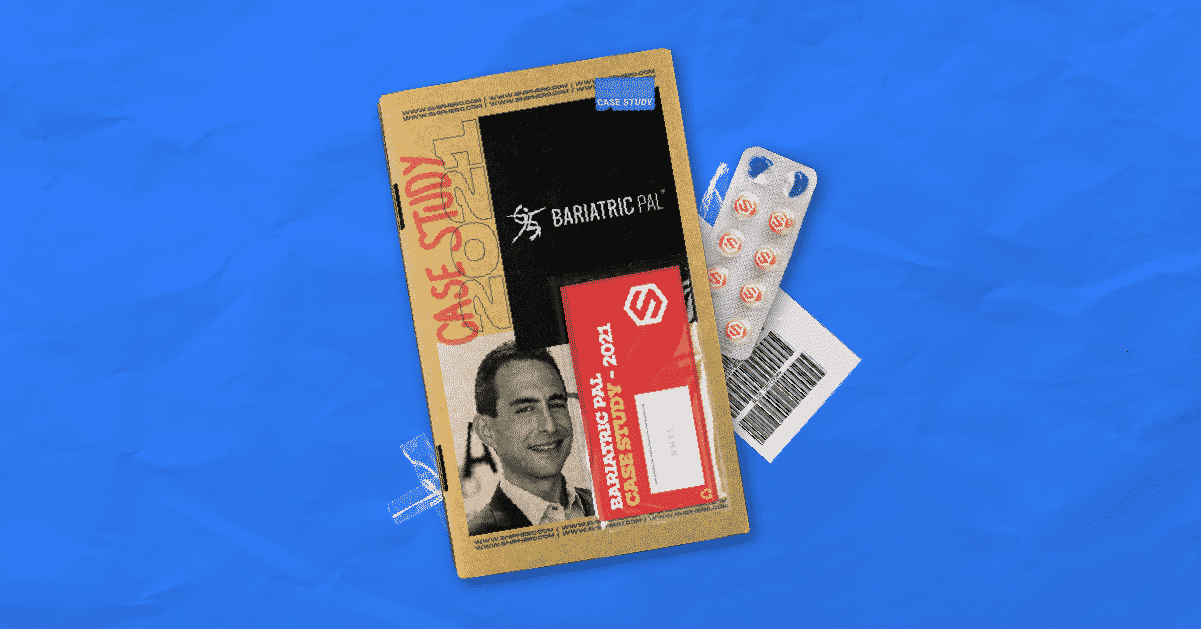
Gym bros, swoll-mates, keto cadets… no matter what you call it, weight-loss and fitness journeys are a lot more fun and successful when you have a trusted companion by your side to support you, motivate you, and keep you on track towards your health and fitness goals.
That’s exactly how this e-commerce CEO’s voyage started -- while embarking on his own health journey and after a personal bariatric surgery, Alex Brecher, CEO of BariatricPal, recognized the need for support, connection, and community.
On the same day that I came home from surgery, I launched a weight loss surgery forum to share information on procedures, diets, and related topics. That was 17 years ago. Now the forum has 374,000 members and over 4.5 million posts.
Alex Brecher, CEO of BariatricPal
In 2015, the BariatricPal store was launched to provide the bariatric community with high-quality food, snacks, vitamins and health accessories. The company currently owns 4 brands: BariatricPal (Store), PatchAid (vitamin patches), NutriNoodle (pastas), and Alex’s Acid-Free Organic Coffee.
Since health & fitness is such an important part of our lives (especially for those of us that gained the Covid-19lbs #thanksgrubhub ????), we just had to sit down and chat with the fine folks at BariatricPal, break down their business into sizable chunks, and chew it over 25 times.
Alex, thanks so much for joining us! To start us off, you look amazing.
Alex Brecher: “You stop, you look amazing.”
Ohhh quit making me blush, you scoundrel! I could lose a couple.
Alex Brecher: “From where??”
Okayyy, that didn’t happen but he does look great -- take 2: Alex, thanks so much for joining us! To start us off, please tell us about your business.
Alex Brecher: "BariatricPal is a brand and online community that offers a one-stop shop for a huge range of vitamins, supplements, and diet food, including 3,500+ products from over 150 bariatric-friendly brands. The story of BariatricPal began in the most personal way – with my bariatric surgery. While embarking on my own health journey, I recognized the need for support, connection, and community.
"On the same day I came home from surgery, I launched a weight loss surgery forum to share information on procedures, diets, and related topics. That was 17 years ago. Now the forum has 374,000 members and over 4.5 million posts.
"As millions of Americans, and countless people across the globe, continue to spend billions of dollars on weight-loss products, BariatricPal’s popularity is showing no signs of slowing down."
What was your fulfillment model before switching to ShipHero? What were the challenges or areas of improvement?
“At first, we fulfilled all orders out of a spare room in my office. After a few months, we switched to a 3PL, which we used from Nov 2015 - August 2017. Due to the growing number of SKUs, we outgrew our 3PL and moved into our own warehouse on 8/17.
"The 3PL was having issues scaling with our growth, and towards the end of our business relationship, we had orders that were massively delayed and inventory took weeks to receive. After crunching the numbers and talking to ShipHero, we realized that we could operate fulfillment for much less than we were paying and at the same time be much more efficient.
"We should be moving to a new, larger warehouse after this summer.”
Congratulations! Crunches to get summer ready, who knew? And what were the main goals for your company when deciding to alter your fulfillment logistics?
“We had two goals. First, we wanted to increase the speed that it was taking customers to receive their orders from the time they placed the order on our site. Second, we wanted to decrease our fulfillment costs.
"When searching for a fulfillment partner, we valued compatibility with Shopify, ease of use, and of course, cost.”
Why did you choose ShipHero?
“Choosing ShipHero came down to three factors:
Just like you, we’re all about supporting our community. What was the experience like integrating ShipHero?
“It was a lot less difficult than I had expected. We did run into a few bumps in the road and support was super helpful, patient and communicative. They held my hand through the entire migration process going from the 3PL to ShipHero.”
We’ll never let go ❤️ What advantages have you seen with using ShipHero?
“It's allowed us to scale our growth and assist us with running a very efficient warehouse operation.
"We also use ShipHero's Bulk Ship feature to ship our subscription boxes each month. Offering a subscription box allows our customers to sample the many new bariatric products we add to our store each month. This allows us to streamline the entire shipping process without our team being required to pick and weigh each subscription box individually. It saves a huge amount of time and our team loves it.”
Ready to start your personal journey to health and wellness? Follow Alex Brecher and get your BariatricPal and associated brands at their website(s).
https://store.bariatricpal.com/
https://www.facebook.com/BariatricPal
https://www.facebook.com/Patchaid
https://www.facebook.com/NutriNoodles
https://www.facebook.com/alexacidfreecoffee/
Want to be featured in our case study?
If you would like to share with us stories about your eCommerce experiences, whether it’s how you started your business, what opinions you have on the stories we share, or if you just feel like venting … we’re here for you.
Shoot us an email and you could be featured on an upcoming Case Study, our critically-acclaimed weekly news segment The Packet, or if you’re lucky, you could be invited to join one of our many Podcast episodes!
While brick and mortar stores are convenient, nowadays eCommerce platforms are growing fast in popularity among consumers and retailers alike. Online stores created with Amazon, BigCommerce, Shopify, and other platforms make the sales process easier for both customers and businesses. However, a digital storefront invites some supply chain management challenges for merchants. Inventory management is essential for smooth order fulfillment, and it directly impacts your online store’s efficiency and growth potential.
What exactly is inventory management, and why should you, an eCommerce business owner, focus on optimizing it? In this article, we'll go over the ABCs of inventory management, detailing the terms and formulas in this field and how you can optimize inventory management for your online store.
eCommerce inventory management is a vital link of the eCommerce supply chain that starts from order placement and ends with the products getting delivered. It consists of the products being picked from the suppliers, stored in the warehouses, and upon the order placement, being picked, packed, and shipped to the destination.
Many 3PL companies handle outsourced fulfillment and inventory management for small and large businesses. Through inventory management, eCommerce companies get a better idea about how products are stocked and how they should be stocked in the future.
Inventory management is related to the direct estimation and organization of the products. It determines the proper functioning of the whole supply chain and can have dire consequences for the businesses if it isn’t optimized. Let’s take a look at some of these consequences.
If inventory management isn’t optimized, your inventory levels could cause problems. For example, overstocking can cause deadstock, especially in the food and fashion industry. No one wants to buy spoiled food or fashion that isn’t in line with current trends. Understocking can hold up the whole supply chain and cause delays that ultimately cost you customers.
If you’re reliant on manual inventory management, it can slow down the whole supply chain. It also doesn’t allow for the business to grow quickly. For example, using a warehouse management system integrated with barcode scanners could save you a lot of time and labor costs compared to workers with manual scanners.
Not having an organized inventory means more errors when fulfilling orders. Customers aren’t happy when they get the wrong products delivered. Having a proper inventory management system with automation can reduce these risks.
Not having a proper inventory management system also means that it is harder to sync with different fulfillment centers in real-time, resulting in potentially dire consequences on sales. For example, let’s say you sell on both Amazon and Shopify. If a customer places an order on Amazon, a lack of coordination can result in orders not being fulfilled or the same order being fulfilled multiple times.
If all the inventory details aren’t accounted for through proper channels, it can become hard to keep track of products. This potentially results in the loss of inventory records and can cause losses for the company in the end.
If the inventory management system isn’t equipped with the proper tech stack, it can often become hard to track the data and then analyze that data. A lack of data analysis means that you cannot correctly measure the inventory performance and often affect future decisions - especially when it comes to demand forecasting and inventory reordering.
Now that we've covered the dangers of not investing in proper inventory management, let’s cover inventory management basics. Of course, inventory management differs from business to business, based on their individual needs and setups, but the blueprint is similar.
You can get an idea of which inventory levels you might need by analyzing past sales performance. Look at your orders based on time frame to look for seasonal trends. Once you have this data analyzed, you can order the right inventory to prevent overstocking or understocking.
This also helps save money on storage costs as you won’t need to lease more warehouse space to keep up with the increase in inventory.
If your eCommerce shop is already up and running, you should set up the minimal stock levels for each product category. These levels measure how much stock you should have at a minimum to ensure smooth operations and prevent a stockout.
To ensure a better customer experience, it’s vital to prepare for busy shipping seasons like holidays. This way, you can ensure enough inventory to cater to the fluctuating purchase orders during a busy shopping season.
To correctly manage inventory, eCommerce businesses usually employ inventory management software. You can typically add integrations like a POS system for purchase orders. QuickBooks for keeping tabs on the bills and receipts, etc.
Inventory management is a versatile field and can be customized according to the needs of your business. There are many inventory management systems like ABC analysis, Set Par Levels system, etc. Here are some essential inventory management terms and systems that you’re likely to encounter.
This inventory management system relies on the principle that the first products to be received by the warehouse should be the first to be shipped to the users. This method ensures that the stock is cycled properly and is especially useful in food inventory management where expiration dates come into play.
This inventory management system is essentially the opposite of the FIFO mentioned above method. Here, the items that are added last to the inventory are the first to be shipped. This method is not suitable for perishable items but is also becoming obsolete in other industries as well.
This particular inventory management system isn’t for those who like to play it safe. Here, the inventory stocks are kept at the minimum possible levels where demands are still met. This is not a suitable system to prepare for emergencies and runs a high risk of out-stocking.
Safety stock is like the safety net for your inventory and helps you overcome emergencies. Safety stock quantities can be estimated by using the safety stock formula that uses the maximum daily usage estimates. The formula for safety stock is mentioned in the next section.
The reorder point measures the minimum inventory level that a business should have before they reorder. This point helps you avoid overstocking and understocking situations and ensures that you reorder the goods at the right time.
Inventory distribution is best when you think that one fulfillment center isn’t enough. This especially helps with cutting down the transit times and shipping costs upon order placement. If your ecommerce business receives a high influx of orders, inventory distribution might be the thing for you.
A perpetual inventory system records the real-time sales and restocking of the inventory stock through inventory management methods. Inventory management software can be used to automate this process. The system records changes in the inventory systems and updates the inventory counts automatically as goods are bought and sold.
When going about inventory management, it's crucial to get things right. A few formulas and metrics related to inventory management can help with the analysis and you can make your future decisions based on them. Here are some commonly used metrics and their formulas.
The finished goods inventory tells about the total stock available for customers to purchase that can be fulfilled. This metric can be used to estimate the amount and value of goods available for sale and how much inventory you need to prevent stockouts. The total value of finished goods can be calculated by this formula below.
To estimate the total costs for holding the unsold inventory including warehousing, insurance, transportation, labor, shrinkage, and opportunity costs, inventory holding costs are used. The following formula can calculate the total inventory holding costs.
Inventory safety stock helps you prepare for unforeseen circumstances by stocking enough for fluctuations. This metric enables you to stay prepared for emergencies and supply chain failures, etc. It is thus the safety net for your inventory stock. You can use the following formula to estimate the inventory safety stock for your business.
Measuring the inventory turnover rate helps you properly estimate and forecast future inventory needs. It essentially is a ratio of how many times inventory is sold and restocked in a specific period to determine the turnover frequency. To calculate the total turnover rate for your business, you can use the following formula.
This is another formula that tells you about the frequency of turnover and lets you assess how many days of inventory you have on hand so you can restock in time and prevent a stockout. You can also estimate the stock lead time with this metric. Use the following formula to estimate the total inventory days on hand for your eCommerce business.
This formula estimates the minimum quantity of stock you should have on hand before you reorder. This ensures both overstocking and understocking. It also makes sure that you reorder before it is too late. Many inventory management systems remind you about this in time. The inventory Reorder point formula is as follows.
Inventory shrinkage occurs when the accounted inventory levels aren’t the same as the actual inventory levels with the latter being lesser than the former. This can occur because of consumer theft, employee theft, management errors, or inventory damage. It is calculated as a ratio. To estimate the total inventory shrinkage rate for your business, use the following formula.
The reorder quantity is the number of goods you should request from a manufacturer or supplier when you restock your inventory. This reorder quantity mustn't be so high that you overstock, and not so low that you run the risk of understocking. The optimal reorder quantity can be estimated by using the following formula.
While you might have a working knowledge of inventory management now, some questions are still unanswered in the above sections. Here are some of the typical inventory management-related questions and their answers.
The four primary inventory types include raw materials, work-in-progress (WIP) inventory, finished goods, and sellable inventory. The WIP inventory includes raw materials, labor, and other overhead costs. Out of the four mentioned inventories, sellable items are the only ones ready to be shipped.
eCommerce stores get their inventory in the form of finished goods directly from a manufacturer or supplier. These goods are then shipped to a warehouse or fulfillment center where they are stored until they are ready to be shipped.
While there are plenty of inventory management techniques, like the ones mentioned in the section above, the commonly used ones include First In First Out (FIFO), Forecasting Demand, and Setting Reorder Points. These techniques can be used for the inventory management of your business.
The Economic Order Quantity (EOQ) is also referred to as the optimum lot size. It is a metric that measures the optimal order quantity for a business such that overstocking and understocking situations are prevented. It also helps a company minimize logistics costs, warehousing space, stockouts, and overstock costs.
ShipHero is a warehouse and fulfillment management software that connects eCommerce sellers and retailers to 3PL companies worldwide.
ShipHero works with integrations of popular ecommerce platforms like WooCommerce, Shopify, Amazon, Etsy, Magento, and eBay, etc. With ShipHero, you can do comprehensive inventory management by managing warehouse locations, returns, low stocks, cycle counts, and many other things. ShipHero allows you to sync your channels through integrations with ecommerce platforms, optimize shipping through robust shipping features, simplify operations through order management, and help from our dedicated customer support team.
With ShipHero, you can set reorder alerts for each product that notifies you when some stock needs replenishment. This way, you can stay on top of your restocking game and ensure that you do not run the risk of being out of stock.
With inventory tracking, replenishment, and reporting all in one place, you don’t have to worry about your inventory’s visibility. ShipHero helps you collect the data through inventory logs and reports and then analyze it to devise optimal inventory management strategies. With reporting and analytics, you can get an idea about how different products are performing on your eCommerce store.
You can create new purchase orders with ShipHero by specifying the supplier and the receiving warehouse. You can also replenish any depleting stock with just a click through the ShipHero dashboard. With ShipHero, you can also keep tabs on any PO change. For the returns processing, you can indicate whether a product is to be restocked or not.
By now, we've established why inventory management is vital for an eCommerce business and how organized order fulfillment encourages a better customer experience. While traditional selling through brick-and-mortar stores requires only one channel to be managed, the modern-day eCommerce setup with multi-channel selling can be more demanding to manage.
But you don’t have to worry about managing your inventory alone because robust logistics solutions like ShipHero provide you with the best inventory management solutions.
So, get started with ShipHero today to make managing your inventory that much easier.
On Thursday, Jeff Bezos released his final letter to shareholders before he relinquishes his CEO title next quarter, to incumbent Andy Jassy, CEO of Amazon Web Services. In the address, Bezos commented on the recent Union election that took place in one of its Alabama warehouses.
“While the voting results were lopsided and our direct relationship with employees is strong, it’s clear to me that we need a better vision for how we create value for employees — a vision for their success."
Jeff Bezos
Keeps poor labor conditions away. Stuart Appelbaum, who led the campaign in Bessemer, Alabama and is the president of the Retail, Wholesale and Department Store Union, says that Bezos’s statement is an admission that their mistreatment claims have been correct, and there needs to be more conversation about how Amazon treats its employees.
“His admission won’t change anything, workers need a union – not just another Amazon public relations effort in damage control.”
Stuart Appelbaum
Workplace injury and rigorous schedules have been the main topics during these Union elections. In his new role as Amazon’s Executive Chairman of the Board, Bezos plans to focus on how to make Amazon’s warehouses safer: approximately 40% of work-related injuries are sprains or strains caused by repeating the same motions over and over. There have also been reports of employees having to use shipping packages and bottles to “relieve themselves” due to a lack of bathroom time. Amazon has denied these claims.
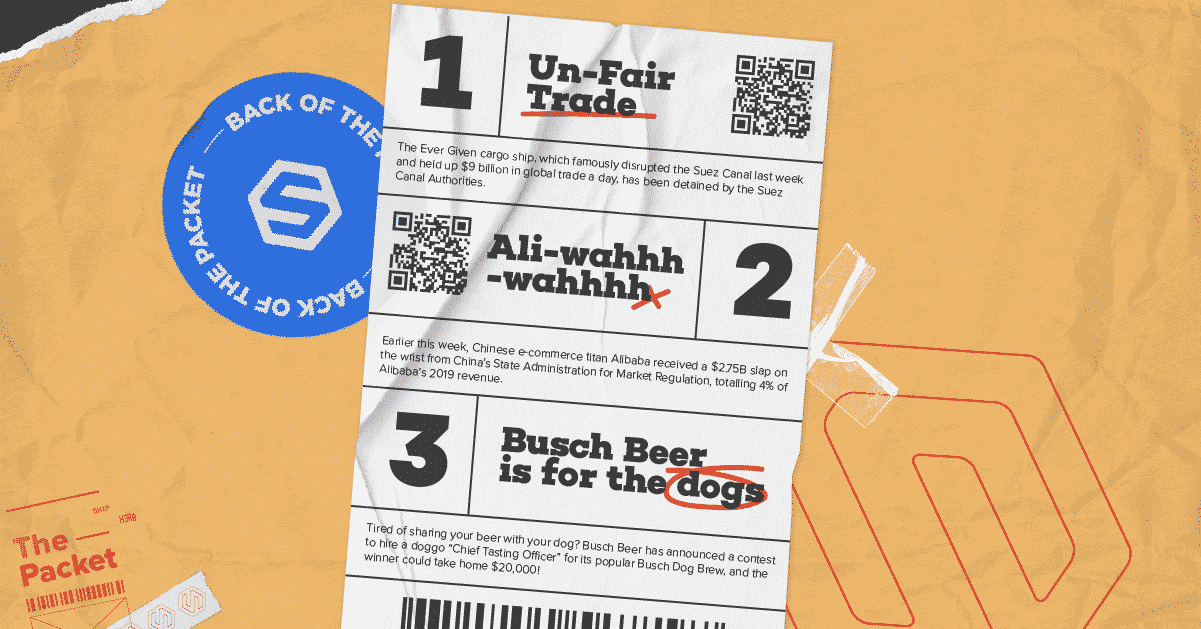
The Ever Given cargo ship, which famously disrupted the Suez Canal last week and held up $9 billion in global trade a day, has been detained by the Suez Canal Authorities, who are calling to be paid $916M in reparations, including $300M for ‘loss of reputation’. In response, the Japanese owner, Shoei Kisen Kaisha Ltd., responded “you know what, keep the ship”. Not really, Shoei Kisen Kaisha and the Suez Canal Authorities are still negotiating a figure.
Earlier this week, Chinese e-commerce titan Alibaba received a $2.75B slap on the wrist from China's State Administration for Market Regulation, totalling 4% of Alibaba’s 2019 revenue. This record fine serves as a conclusion to their high-profile antitrust investigation, which came months after Jack Ma’s criticisms of the Chinese regulatory system. In a press statement, Alibaba called the fine "an important action to safeguard fair market competition", and then went and pouted in time-out.
Tired of sharing your beer with your dog? Busch Beer has announced a contest to hire a doggo “Chief Tasting Officer” for its popular Busch Dog Brew, and the winner could take home $20,000! To enter, post a picture of your pooch on social media with the hashtag #BuschCTOcontest... so animal services can come pick them up. JK sounds fun, good luck.
Breaking: Shopify reveals that sellers accrue $2 trillion in costs due to inventory mismanagement like overstocking, out-of-stock items, and preventable returns. Learn how to master your inventory management and reduce your costs with the simple steps given in our latest blog. Check it out!



.svg)