
.svg)

Find out how to measure your warehouse management system ROI and effectively build a compelling business case.

.svg)
In a world where margins are tight and customer expectations are sky-high, investing in a warehouse management system (WMS) helps keep orders fulfilled around the clock.
However, the real question isn't whether to invest in a WMS; it is how to justify the investment and calculate the true return it delivers.
Businesses that build a strong business case and track measurable outcomes from their WMS implementation consistently play their cards right than those that don't. They scale faster, experience fewer fulfillment errors, and save significantly on labor and inventory costs.
This article will help you build that case, calculate the ROI of a warehouse management system, and demonstrate long-term business value.
To justify the investment in a WMS with measurable benefits, start with the right metrics.
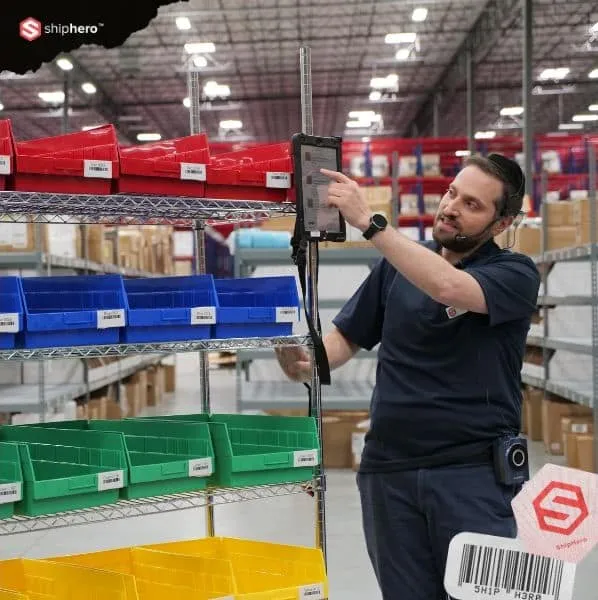
One ShipHero customer reported a 30% increase in their picking efficiency. Their staff now picks 70-80 orders in an hour, thanks to ShipHero’s iPad-enabled picking process.
A strong business case isn't just about numbers. It's about clearly showing the value of WMS implementation across every part of the operation.
Short-term ROI refers to immediate, quantifiable improvements in areas like:
Long-term ROI, on the other hand, reflects sustained gains over months or years, such as:
For example, a brand might see a 30% labor savings within the first quarter, but the long-term cost savings of a WMS come from optimizing processes over the years and avoiding major expansion costs.
Direct ROI is quantifiable, easily measurable financial gains that result directly from WMS implementation. These could be:
Indirect ROI, on the other hand, is intangible, benefits that may not show up immediately on a financial statement but significantly impact business performance over time. This includes:
Most businesses struggle to assess the long-term cost savings of a WMS because they hyperfocus on the direct ROI to justify the initial investment. But indirect ROI underscores the strategic, long-term value of a WMS.
Peak seasons are high-stress, high-stakes, but a WMS helps implement automation to streamline warehouse operations and minimize chaos.
Challenges include:
ShipHero clients using our WMS manage multiple warehouses more efficiently, especially during the holidays, enabling them to meet SLAs and reduce overtime. WMS advantages include:
Below are case studies proving how WMS can drive measurable gains in efficiency, accuracy, and fulfillment speed.
James Enterprise, a veteran in the sales and distribution industry, turned to ShipHero’s WMS to overcome inefficiencies such as batch processing, error-prone paper pick tickets, and latency issues.
They needed a solution that could scale with them while reducing costs and streamlining fulfillment. Implementing ShipHero helps them as follows:
B2C business Vareya transitioned to ShipHero’s end-to-end Warehouse Management Software to consolidate its fragmented systems into one cohesive platform. Previously, they struggled with software that didn’t communicate, leading to inventory blind spots, delayed shipments, and frustrated customers.
ShipHero’s robust reporting improves inventory management with real-time tracking and reduces stock errors and inventory discrepancies.
Vareya and its clients now receive instant notifications when stock is low or an item hasn’t shipped, allowing them to respond quickly and avoid disruptions.
In less than two years of implementing ShipHero’s WMS, lifestyle brand American Tall’s orders increased by over 400%. It was the most intuitive solution they had tried, helping them keep up with order fulfillment while their business grew.
Meanwhile, Deliverzen, a growing 3PL provider, used to struggle with bottlenecks that made handling increased order volumes nearly impossible. ShipHero WMS helped scale operations to meet surging customer demand. The results?
"ShipHero has helped us scale without worrying about system breakdowns. It's reliable and gives us peace of mind," Drew Horner, Owner of Deliverzen.
Before making the leap, here’s a balanced look at what your business can expect when implementing a WMS:
Yes, though it depends on your baseline metrics. Leading platforms like ShipHero provide detailed dashboards that allow you to monitor warehouse performance and measure results post-implementation.
Absolutely. When you integrate the WMS with existing enterprise systems like ERP or CRM platforms, you streamline data flows and enable better cross-functional decision-making.
Yes. Training is critical. Without it, your team can't fully leverage features like automation, real-time tracking, or KPI dashboards. Training also ensures you track key performance indicators (KPIs) to assess success from day one.
.webp)
Discover the role, benefits, key features, requirements, and implementation of a 3PL Warehouse Management System (WMS) for optimizing warehouse operations. Learn about scalability, integration, real-time visibility, and customization options to choose the best solution for your business.
.svg)

Explore the top 3PL companies in Canada and learn how third-party logistics providers play a vital role in optimizing supply chains. Discover the benefits of partnering with a 3PL, key services offered, and steps to start working with a 3PL in Canada.
Discover the top 5 best third-party logistics (3PL) companies for your business needs, offering extensive networks, advanced technology, and superior customer service. Learn about the benefits of 3PL services, how to choose the right provider, and avoid common mistakes.

Why Keyboards Are Killing Your Pack Line (And What to Do About It). Stop losing throughput to keyboards and mice. ShipHero's Tap-to-Pack replaces screen navigation with an 8-button industrial controller built for 99.9% packing accuracy.





.svg)



.webp)