.svg)

Let’s stay in touch with the ShipHero Blog.


.webp)

Look at those gains, bro. Over the last year, the dietary supplement industry has boasted bulging sales growth of 40%, outpacing overall e-commerce by 12%, and they swear it’s all-natural…
The pandemic has certainly brought more awareness to immunity, and overall health and wellness; in fact, 77% of American adults consume dietary supplements, and the average American spends around $56 per month on dietary supplements.
Of course, there are other ways to increase immunity and health, such as at-home workout products and healthy meal kits, but those haven’t grown at nearly the same rate as supplements. So that begs the question...
How have supplement companies dominated e-commerce?After searching through the supplement industries’ gym bag of secrets, we found that the true secret to their success with the injection of three strategies: (Serving size: one scoop of each)
Disclaimer: Ingestion of the following strategies will give you and your e-commerce business a sick pump.
The Subscription Model, or “Subscribe & Save”, is where customers subscribe to weekly, monthly or seasonal purchases and receive discounts upwards of 15% off. Think content streaming services like Netflix or Hulu, recurring subscription box companies like BirchBox, and more recently, supplement and vitamin companies.
Companies that employ the subscription model offer recurring products or services, rather than the traditional, one-time transaction. Brands and businesses that have utilized this approach have reported better customer relationships, improved aggregate data, and more diversity in product offerings.
Turn Customers in Subscribers
Most large companies report that new customers only generate 15 to 25% percent of their revenues, which means that return customers generate the bulk of the revenue. Focusing on return customers and subscribers reduces acquisition costs of targeting new customers, while cultivating brand loyalty.
Gather More Fruitful Customer Data
As reported by Shopify, modeling and storing subscription data allows your company to better engage with your audience and create targeted content along the customer journey. In fact, many large brands develop separate marketing strategies for subscribers and non-subscribers, as well as strategies to convert non-subscribers to subscribers, including email campaigns and targeted discounts for subscription and account creation.
Sell the Same Product in Multiple Ways
The subscription model gives brands the creative freedom to understand how their customers would prefer to engage with their products and services.
Beyond the price discount, supplement companies could offer subscribers access to free delivery, early bird offers, free trials or samples, gifts with purchase, and much more. As you learn from your subscribers, you are free to adjust your product offerings to better meet their needs!
If you want to learn more about how to create a successful subscription model, check out our blog.
Bundles, or as they’re called in the dietary supplement industry -- stacks. Supplement stacks are a bundled variety of supplements for one specific health goal; for example, popular supplement stacks are for the ketogenic diet, weight loss, muscle gain and more.
Bundling products allows companies to cross-sell, provide a more convenient shopping experience, and give customers more flexibility.
Cross-Sell
Bundles are the perfect way for supplement companies to cross-sell products. By intelligently combining multiple products into one item, supplement companies bundle their popular and top-selling supplements with products that normally might not sell on their own (looking at you L-Carnitine). Also, if you have multiple flavors of a gut-drink for example, you can bundle together a variety pack!
Convenience
With just one click, customers can purchase all the supplements that they need. And if you are using the subscription model, their supplements will be auto-fulfilled based on their desired cadence!
Flexibility
Some supplement providers like G Fuel offer their customers the flexibility of building their own bundles -- BYOB but healthy!
Any supplement company can promise a lucrative subscription model with convenient and flexible bundling options; but in reality, these are extremely complicated to pull off without the right inventory management and order fulfillment process.
In fact, most 3PLs and fulfillment providers simply don’t offer the customization and bundling options that supplement companies need. That’s why you need to supplement your business with the right fulfillment provider.
Convenient Bundling
Through traditional fulfillment methods, creating and shipping customized bundles, kits or bulk orders can be highly complex and downright costly. By offering a subscription service, your brand can sell a variety of items in a variety of ways, so brand owners must be able to group orders quickly and pick a lot of the same product at once, making the fulfillment process quick and simple.That’s why ShipHero is dedicated to supporting our subscription-based and bundle supplement companies with our newest capability, BulkShip!BulkShip is an intuitive interface to design preassembled bundles of products, such as a BodyBuilding Stack or a more flexible bundle that would get assembled at fulfillment - like the Build-Your-Own-Bundle option.
Safe Storage and Transport
Supplements must be stored in cool, dry areas, or they risk discoloration, odor, and deterioration. Make sure that your fulfillment provider can take the necessary precautions to protect your inventory in a safe, secure, and climate controlled environment, and take care during the transportation.
Reliable Shipping
Supplements and vitamins are taken regularly and on set cadences, so having a reliable shipping carrier with built-in resiliency is of the utmost importance. This year has shown that even the most popular carriers, FedEx, UPS and Amazon, are all subject to delays and unreliable shipping times. That’s why ShipHero has seen a huge surge of supplement companies looking to diversify their shipping methods, so that their customers and subscribers receive their supplements when they’re supposed to.
.svg)
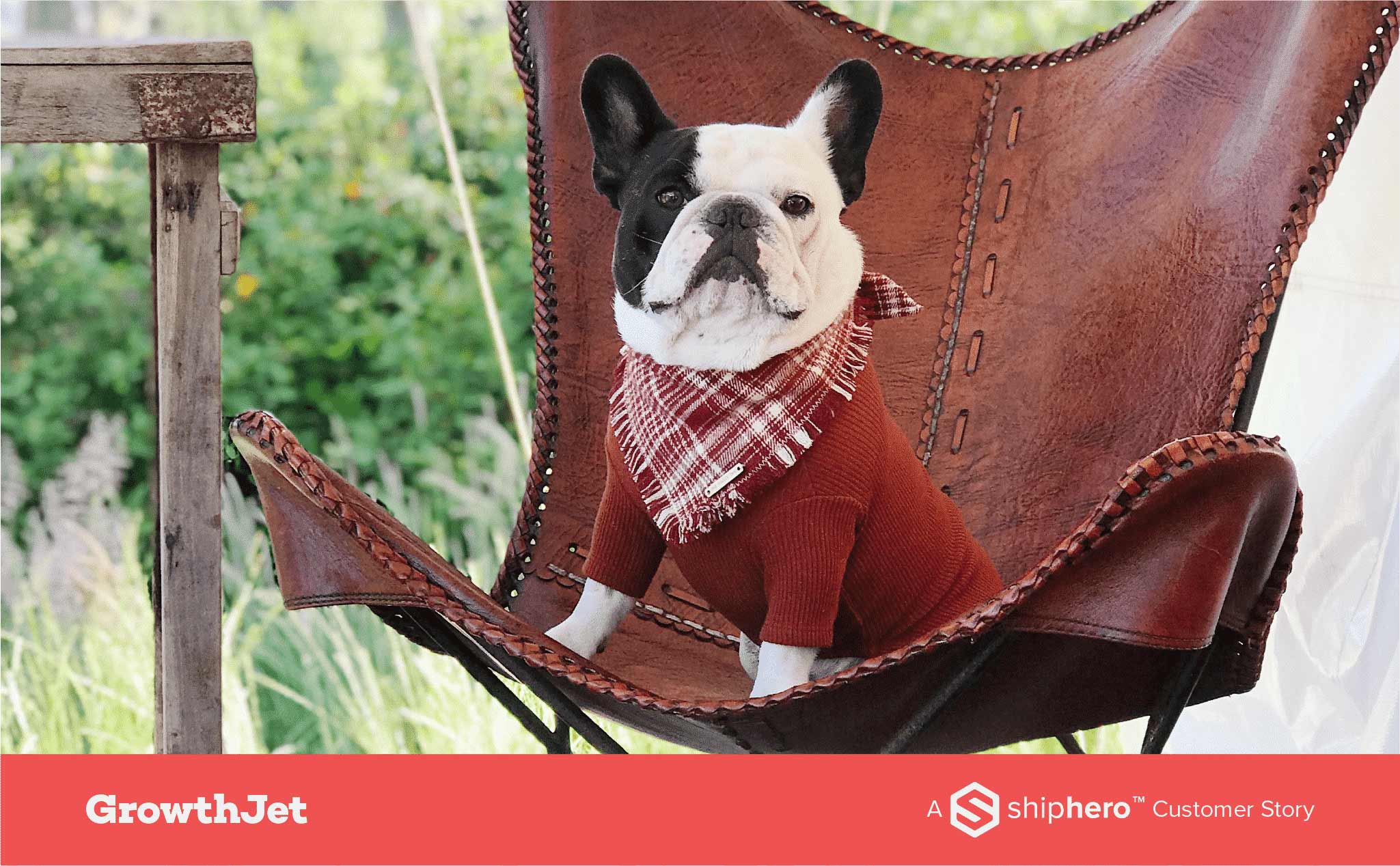
Move over Air Bud… Humphrey the French Bulldog may not be able to sink a three pointer, but he can sell dog accessories while saving the planet like it's nobody’s business. Except, it is his business! Enter: Spotted By Humphrey -- a specialty dog boutique with a playfully curated selection of thoughtfully-designed, well-made, premium dog accessories, which comes along with a promise of net-neutral climate emissions.
Spotted By Humphrey - “with its quirky name for a shop that has the personality to match” - is a community-driven online destination for dog parents around the world who are looking to find something special and unique for their dogs.
Humphrey aka Spotted Humphrey (@spottedhumphrey) has over 120K followers on Instagram, and is the inspiration behind the business, as founders Sandy and Yong-Soo Chung (also Humphrey’s parents) wanted to create a shop that would make the experience of shopping for your dog just as fun and community-oriented as Humphrey’s Instagram.
Naturally, social media plays a key element in the shop’s marketing strategy; however, both Sandy and Yong-Soo believe that their success largely comes from establishing a strong operational foundation, which ultimately creates a better experience for their customers.
Having founded his own ecommerce shop Urban EDC Supply prior to the launch of Spotted By Humphrey, Yong-Soo leveraged his existing ecommerce experience to establish Spotted By Humphrey, which Sandy has taken on and grown organically ever since. Yong-Soo eventually founded an all-encompassing ecommerce brand accelerator with the first ever net-negative carbon emitting 3PL in the industry, so every shipment that goes out actually benefits the planet instead of harming it.
"Frustrated by the lack of accountability and execution, I decided to take fulfillment in-house. First, we used another WMS other than ShipHero. It was slow, we had a lot of mis-shipments, and it was difficult tracking inventory. When I finally stumbled upon ShipHero, it was a game changer. The software was intuitive to use and it had a lot more features that made it easier to streamline our fulfillment operations."
-- Yong-Soo, Founder and CEO of GrowthJet
Yong-Soo utilizes ShipHero’s warehouse management software across his ecommerce brand accelerator, GrowthJet, along with his two internal brands, Spotted By Humphrey and Urban EDC Supply, a boutique everyday carry shop. So we asked Humphrey and Yong-Soo to ‘sit, stay and roll over’ what made ShipHero the right choice for his business.
ShipHero: Humphrey, tell us about your business(es).
Humphrey: OUAF OUAF!
SH: Ah, I don’t speak French. Yong-Soo, care to translate?
Yong-Soo: “In a nutshell, GrowthJet is an ecommerce brand accelerator with two internal brands, Urban EDC Supply (launched 2015) & Spotted By Humphrey (launched 2018).
Urban EDC Supply is an everyday carry shop with a strong focus on the EDC and knife community. We collaborate with world-renowned designers like Jesper Voxnaes to create stylish and functional everyday carry gear for our community of gear enthusiasts. Taking a page out of the streetwear clothing culture, weekly drops feature a limited supply of exclusive goods that sell out within hours, and sometimes minutes, or even a few seconds. While there’s a wide range of goods available for sale, some of these high-end collectibles can sell for as much as $2,000.
Spotted By Humphrey is a specialty dog boutique inspired by our french bulldog, Humphrey. As of today, Humphrey has 120k followers (@spottedhumphrey) on Instagram. We wanted to create a shop that would make the experience of shopping for your dog fun and community-oriented. Sandy and Humphrey made an appearance on the first episode of Shopify’s “Guess My Hustle” series (produced by Portal A, an award-winning digital studio), as well as Shopify’s “New Money” series (episode titled, “How To Make Money In The Million Dollar Dog Accessories Industry”).
Having built two fast-growing brands, in 2019, several colleagues approached us asking about our product photography, our fulfillment operations, and other e-commerce related ops questions. We decided to build and launch GrowthJet as the backbone infrastructure support to grow e-commerce brands. We've been growing very quickly through word-of-mouth ever since.”
SH: During your journey, you went from using a third party logistics (3PL) provider to fulfilling on your own. What was the catalyst for this switch?
Yong-Soo: “When I launched Urban EDC Supply back in October 2015 from my one-bedroom apartment in San Francisco, I did a tremendous amount of research on finding the best 3PL. After weeks of digging in, I settled on a 3PL that was based here in the Bay Area, and one that had the best reviews and ratings.
Unfortunately, I had one of the most frustrating experiences with this particular 3PL. I lost close to $5,000 worth of inventory due to negligence by the fulfillment staff. There was one particular instance where one of the employees opened up the box that was being shipped to my customer, took the item out, and then shipped out an empty box to my customer in Alaska. It turns out that this particular employee's last day was the next day. When confronted with this news, the employee never returned to collect his final paycheck the next day.
Frustrated by the lack of accountability and execution, I decided to take fulfillment in-house.
SH: Sounds like they were in the doghouse, eh Humphrey?
Humphrey: RUFF!
SH: Too true, too true. So when you were searching for WMS solutions, what were your main fulfillment goals?
Yong-Soo: “When we took fulfillment in-house and launched GrowthJet, the main goals were to improve order accuracy through proper barcoding, speed up the process of fulfillment, and generally, have more accountability and insight into our shipment data.
For us, the [most important criteria] was our ability to have an open dialogue with our fulfillment center. When we needed something, calling a phone number and being greeted by a "voice mailbox is full" message is never fun. Neither is sending out an urgent support email and not receiving a response for over a week. So for GrowthJet, we made it a point to be transparent and open to communication. Also, the ability to flex and work collaboratively with the 3PL is an important part of what we do at GrowthJet.”
SH: And why did you choose ShipHero?
Yong-Soo: “First, we used another WMS other than ShipHero. It was slow, we had a lot of mis-shipments, and it was difficult tracking inventory. When I finally stumbled upon ShipHero, it was a game changer. The software was intuitive to use and it had a lot more features that made it easier to streamline our fulfillment operations.
Integrating ShipHero was relatively easy, especially with one of the Solutions Engineers Matt D. helping us.”
First, we used another WMS other than ShipHero. It was slow, we had a lot of mis-shipments, and it was difficult tracking inventory. When I finally stumbled upon ShipHero, it was a game changer. The software was intuitive to use and it had a lot more features that made it easier to streamline our fulfillment operations.
SH: Every ShipHero customer is assigned a Solutions Engineer to help simplify the onboarding and integration process because we look after our customers, dawg.
Humphrey: ...
SH: So what was your inspiration for the climate neutral pledge, and how do you plan to become a Carbon Negative 3PL?
Yong-Soo: “When we launched GrowthJet, we realized how bad the waste and carbon footprint is for logistics and fulfillment. We think a lot about ecosystems not only for the environment, but the entire lifecycle of every item that comes through our warehouse including packaging materials, pallets, used equipment, etc.
We want to reduce as much as possible, then reuse, then recycle what we can before we decide to throw something away. Even then, we offset the carbon footprint of our garbage by purchasing carbon credits through ClimateNeutral.org.
On top of our Climate Neutral certification, we will be implementing our own tree-planting initiative in 2021. As far as we know, we will be the first carbon negative 3PL in the world. This means that for every package we ship out for our brand partners, we're actually helping our planet fight against climate change. Counter-intuitive, isn't it?
SH: Planting trees to help climate change, care to comment Humphrey?
Humphrey: BARK!
SH: Surprisingly on topic. And what has been the response from your customer base?
Yong-Soo: “Overall, the response from our brand partners has been very positive. They love and appreciate our proactive commitment to saving our planet, rather than being part of the problem. We're also different from most 3PLs in that we're more selective about who we bring on as a partner. We want to make sure we're aligned on values first and foremost. Like any relationship, it's a two-way partnership. We have a bias for thinking long-term so we want to make sure there's a fit first before making a long-term commitment.”
SH: Finally, how has your business been impacted by the COVID-19 pandemic and lockdowns?
Yong-Soo: Our business actually saw an increase due to COVID. With e-commerce getting a huge boost, we were fortunate to be in a position of leverage during the pandemic. Of course, there were additional costs such as PPE equipment and being more cognizant of social distancing within the warehouse, but all in all, we feel very lucky to come out of the pandemic stronger than before.
SH: Amazing, thank you for sharing your story and allowing us to write this case study. Humphrey, final thoughts?
Humphrey: WOOF WOOF!
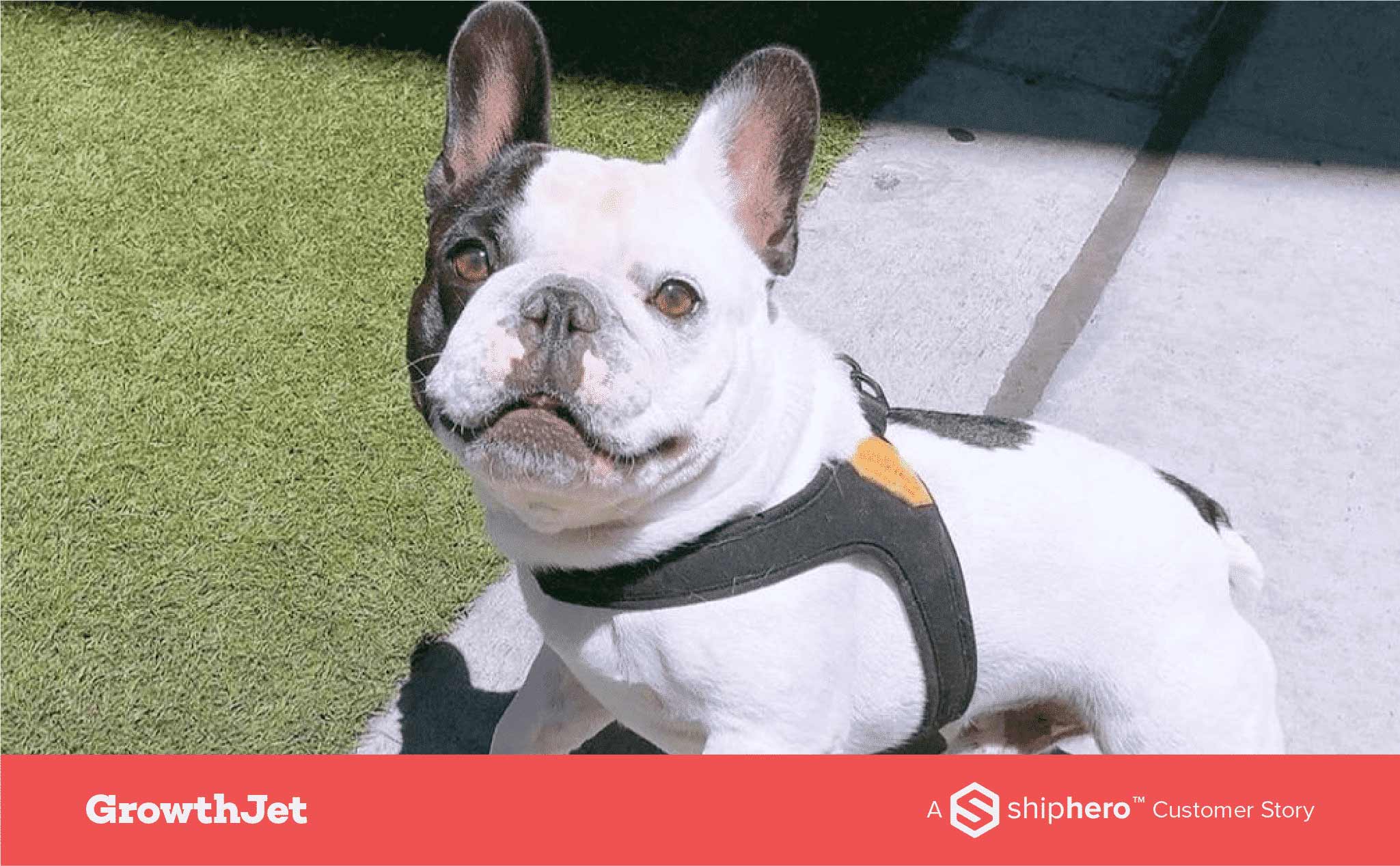
Follow Humphrey and the Spotted By Humphrey’s journey at their website and Instagram.
Website: https://spottedbyhumphrey.com/
Humphrey’s Instagram: https://www.instagram.com/spottedhumphrey/
Spotted By Humphrey Instagram: https://www.instagram.com/spottedbyhumphrey/
Want to be featured in our case study?
If you would like to share with us stories about your ecommerce experiences, whether it’s how you started your business, what opinions you have on the stories we share, or if you just feel like venting… we’re here for you.
Shoot us an email and you could be featured on an upcoming Case Study, our critically-acclaimed weekly news segment The Packet, or if you’re lucky, you could be invited to join one of our many Podcast episodes!

The incumbent President of the United States made quick work in demonstrating to our citizens and the rest of the world exactly what our country’s priorities will be for the next four years and beyond. Within his first week of taking office, President Joe Biden enacted a long list of executive orders that sought solutions to the pressing issues stemming from the COVID-19 pandemic, immigration, and climate change.
Sustainability has been of great importance to the Biden administration since his Vice Presidency, and continued to be a main aspect of his campaign during the 2020 election, so it came as no surprise when President Joe Biden signed an executive order to initiate his plan to combat climate change through a Clean Energy Revolution and Environmental Justice.
No matter who you voted for, it’s time to get acquainted with his stance on climate change, what measures the government will be taking to lower our carbon footprint, and how the logistics industry will be impacted. In essence, it comes down to carbon emissions and the railroad.
Under Biden’s leadership, the United States rejoined the Paris Agreement on climate change, which calls us to determine a reduction target for emissions and direct our federal agencies to execute on that promise.
For example, US agencies have been directed to purchase American-made, zero-emission vehicles, and suspend new oil and natural gas leases on public lands in hopes to conserve at least 30% of federal lands and waters over the next ten years.
The Biden Plan for a Clean Energy Revolution and Environmental Justice also promises to make major public investments in automobile infrastructure, including 500,000 electric vehicle charging stations, while accelerating R&D on battery technology and battery production. This is sure to increase production and widespread use of EV vehicles, buses, and trucks for transportation.
Sustainability
As the current pandemic situation unfolds, sustainability in the supply chain has gone by the wayside as urgency and necessity push for speed and reliability in shipping. But even still, some shoppers opt to use the Amazon Day feature to try and offset their purchases with their rationale being, if they have to come here, at least let them bring more than one thing. Post-COVID however, sustainability will be sure to resume as a large priority for consumers and retailers once more.
For fulfillment providers, retailers will push for low-carbon and zero-carbon (if not negative) emissions throughout the supply chain. There will be a push for clean transportation options, namely electric vehicles (EV) including electric trucks for long-distance shipping, whereas air freight has the worst carbon emissions.
Although it remains unclear what Environmental Justice specifically entails, we don’t find it out of the realm of possibilities that a national carbon tax could be introduced similar to Canada, Britain or some US states, or rather an incentivized stimulus for low-emitting companies. If enacted, a carbon tax could make logistics companies like Amazon rethink their air-heavy fulfillment strategy and make way for 3PLs that are built on sustainable practices.
But where, WHERE, are these sustainable transportation methods coming from?, you may have shouted into your computer screen. Well, toot toot, the answer to that falls on…
Biden’s plan aims to spark “The Second Great Railroad Revolution”, a push to modernize US rail infrastructure, which will ensure that we have the cleanest, safest, and fastest rail system in the world — for both passengers and freight.
A US Rail Revolution will not only reduce pollution, by working with Amtrak and private freight rail companies to further electrify the rail system, but also provide workers with “good, union” jobs and stimulate investment in communities better linked to major metropolitan areas. In order to streamline the loan process and make capital more available for the railway industry, Biden has tapped existing federal grant and loan programs at the US Department of Transportation.
Multi-modal
Currently, fulfillment is dominated by ground travel, with long-distance trucking and last-mile delivery vans. Although rail freight can carry 400 times what a single truckload can with much fewer emissions, the current process for fulfillment by rail is too complex and downright costly. However, Biden’s plan could be the answer for this.
By modernizing rail freight and designing it for today’s eCommerce world, rail freight could once again become a viable option, and 3PL providers that account for this shift could disrupt the logistics industry entirely by cornering the multi-modal transportation space.
Multi-modal transport (also known as combined transport) is the transportation of goods under a single contract, but performed with at least two different modes of transport, often performed by contracted sub-carriers. The carrier responsible for the entire carriage is referred to as a multimodal transport operator, or MTO.
So, any 3PL that can become the leading MTO could position themselves to become the 4th major player in logistics and fulfillment, with UPS and Fedex at capacity, and Amazon weighed down by its traditional infrastructure.
We’re no fulfill-osophers, but we do predict that a smart logistics provider like ShipHero, one built to scale through agility, will be perfectly positioned to quickly claim market share and delight their customers with sustainable shipping and multi-modal options.
Through use of already existing clean energy and green technologies, the logistics industry can lead the way towards sustainable practices in eCommerce supply chains. Moreover, the pandemic-caused boom of eCommerce has given rise to a plethora of opportunities and growth in the fulfillment space; and where money goes, progress follows.
Investments to improve fulfillment practices driven by big data and blockchain will be the spark necessary for companies to derive ROI from their sustainable practices, and effectively contribute to Green Joe’s climate plan.
Learn more about ShipHero's industry-leading warehouse management software.

Welcome to our Shipping Methods Explained blog series. In this series, we will deep dive into fulfillment methods - that is, how businesses fulfill their online orders and get products to their customers. Sounds simple right? Well, in theory it is. You could hop on your itty-witty bicycle and hand-deliver your product, mission accomplished. But consider the complexity when your company fulfills hundreds to thousands of orders daily, not to mention the skyrocketing shipping costs that could price you out of the market. Managing inventory, navigating each carriers’ specific requirements, calculating the lowest cost from thousands of shipping options… it’s a daunting task. That’s why more and more businesses are outsourcing their fulfillment methods. Are you ready to outsource your fulfillment? Let’s analyze your options to help you decide the best method for your business. In this article, we’ll discuss Dropshipping. What is dropshipping? What are the pros/cons? When is it right for my business? Let’s dive in.(And be sure to check back for future articles where we’ll cover even more fulfillment methods)
Dropshipping is the term used when a product is shipped directly from a manufacturer, supplier, or wholesaler, bypassing the retailer that made the sale entirely.
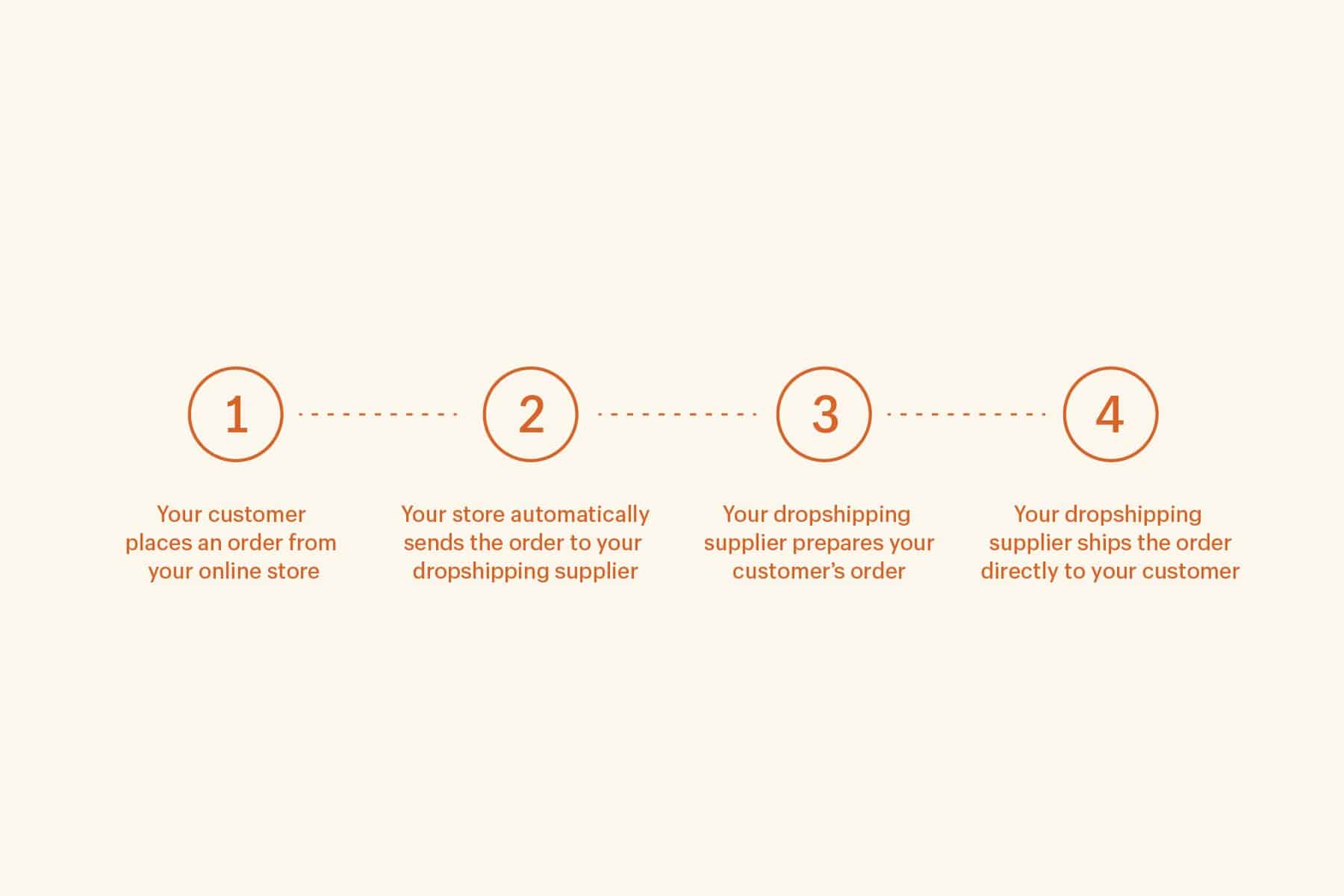
SOURCE: https://www.shopify.com/blog/what-is-dropshipping
Dropshipping businesses are extremely common nowadays, due to the allure of making a passive income matched with the simplicity of setting up a dropshipping business. All it takes is 3 easy steps to get you on your way.Step 1: Choose a Product/NicheThe first step you take in starting a dropshipping business is to choose what you are going to sell. Your product could be a brand new gadget, or a low-cost version of a luxury item, or a luxury version of a low-cost item. As long as there is a market for it, there are no wrong choices here. So do your due diligence and find a product that you think you could sell. ABC… Always be closing.Step 2: Find a Dropshipping SupplierOnce you choose your product, find a dropshipping supplier. You can search a supplier database like Dropship Direct, Alibaba, or AliExpress. (Although be sure to stay up-to-date on news concerning Chinese dropshipping providers)Alternatively, you can use an integrated supplier directory. This means that when you build your online store, say in Shopify (see Step 3), the dropshipper will be linked directly to your online store. Shopify recommends the easiest integration is with the Oberlo marketplace. From here, choose from millions of products and upload them directly to your store. Step 3: Build Your Online StoreAfter you have your product and supplier, have some fun building your online store! This will serve as the grand entrance to your brand. Websites like Shopify, Wix and 3DCart allow you to build your online store from scratch, or select from pre-made templates. When choosing between your options, make sure your choice gives you the ability to easily integrate with your dropshipping supplier.When designing your store, keep in mind who your target audience is, and build your website to reflect their wants and needs. Not just in appearance, but in website functionality. You can turn customers into repeat shoppers through a convenient and fluid shopping experience.
Is dropshipping right for your business? Or would you benefit from a third-party logistics provider or another fulfillment method? Let’s look at the pros and cons of dropshipping so you can decide for yourself.
Dropshipping is the perfect business model for those that want to earn a passive income. It’s simple to start, with little to no cash investment. You can quickly test your ideas with limited risk to you. The three main advantages to dropshipping are:Less Capital is RequiredDropshipping eliminates the need to invest heavily in inventory, warehouse fees, transportation fees, etc. so anybody with a laptop and a dream can start an online business.Able to Offer Wider Range of ProductsWith dropshipping, you don’t have to purchase inventory until the sale is made, which significantly reduces the risk to you. So this gives you freedom to offer a large array of products on your site.Simple to StartWith companies like Shopify that basically make the entire process a drag-and-drop activity, starting an online business has never been easier.
The pros listed above explain why so many people have started an online dropshipping store, and why they use dropshipping to expand their product lines. But for the very same simplicity and low costs that attract these entrepreneurs, dropshipping also presents a set of challenges.Low Profit MarginBecause the barriers to enter the dropshipping market are very low, the competition is fierce. Having many sellers in the market pushes down the cost as they compete with each other. Sure, you can differentiate based on branding, customer service, etc. but at the end of the day, $$$ talks.Little to No CustomizationBecause you are at the will of your supplier, they rarely offer any customization to your products, your packaging, or your unboxing experience. Say you want to make the slightest tweak to the look of your item, or you want to pack it a certain way or in a bundle, this will most likely not be possible. Some Alibaba dropshipping suppliers will accommodate and customize, but even then, they fully control the product and could even turn around and sell your customized goods to the next retailer.Little to No ControlYou entrust the entire fulfillment process to the supplier, and accept the quality of service that they provide. If there are errors or mistakes, you cannot blame your supplier and it will be your brand that pays the price. Maybe not in dollars, but certainly in reputation.So, is dropshipping right for your business? If you’re not sure, stay tuned for our next article as we dive into third-party logistics (3PL) and fulfillment providers like ShipHero.Learn more about ShipHero's industry-leading warehouse management software.
Objects! with ShipHero talks with the entrepreneurs, innovators and idealists that put items on the shelf and bring packages to your doorstep. From hot sauce to board games, toothbrushes to frying pans, startup side-gigs to enterprise players, join ShipHero founder, Nicholas Daniel-Richards, as he demystifies the manufacturing and logistics behind some of our most beloved household objects, with transformational ideas that are guaranteed to make you say, why didn’t I think of that?. This fast-paced and intriguing podcast covers thousands of travelled miles in less than an hour, so next time you’re standing in your local store and see a label that says ‘Made in <A Land Far, Far Away>’, you’ll know just how it got into your hands.Objects! with ShipHero discusses in detail what it takes to transform an intangible idea into a tangible object that is designed, sold, manufactured, shipped, and delivered in the digital world. If you are a successful entrepreneur looking to grow or an aspiring innovator with an idea, Objects! with ShipHero provides a detailed, 360' exploration with the masterminds behind modern ecommerce and shipping solutions. So settle in, buckle up, and prepare to get objectified! ... no wait, not that. Get ready to say “I objects!”... we’ll work on it. Available on iTunes and at this link.
Episode 3 of Objects! with ShipHero released right around the holidays to remind us what’s really important this time of the year… toys, toys, toys and toys. So Nicholas sits down with Dr. Lisa, former university professor and creator of The Fresh Dolls -- the first line of authentically beautiful, multi-cultural dolls to represent and celebrate diverse ethnicities. Not only are these dolls Finalists for the 2021 Toy of the Year Award, but they are currently featured on Oprah’s Favorite Things list; yes, THE Oprah. In this conversation, Dr. Lisa shares what drove her to take a sharp career turn from academia to toy manufacturing, what challenges she faced with her factories, and what it takes to launch a brand new doll from scratch. It’s a wild ride, so buckle up doll face (it’s a compliment, we checked).
Dr. Lisa earned her PhD degree in Marketing and Supply Chain from “The” Ohio State University, where she was the first African-American woman to earn this degree in her field. To say she developed a successful career in academia is certainly an understatement as she was the highest ranking professor in her field, quickly received tenure, obtained various faculty positions, and became the first multi-million dollar endowed chair holder when she was recruited to the University of Arkansas to chair her department.It was at the University of Arkansas where she made connections with a local Arkansas-based company you may have heard of, Walmart. Things were looking good for Dr. Lisa, having realized her childhood dream of becoming a professor. But one fateful day, Dr. Lisa stumbled upon an old study from Drs. Mamie and Kenneth Clark.“One day while watching an updated doll study, I saw a beautiful little dark-skinned girl say she didn’t think the brown doll was pretty because its skin was nasty. She then touched her own hand indicating her skin was nasty, too. As my heart broke and tears flowed down my face, I said to myself, ‘I have to do something. This can’t happen on my watch’. A generation of children can’t grow up not knowing their true beauty and brilliance.” -- Dr. LisaSo in 2003, Dr. Lisa founded the World of Entertainment, Publishing and Inspiration (World of EPI) to produce dolls that inspire dreams, promote intelligence and build self-esteem for all children.
Dr. Lisa immersed herself in the world of doll-making and quickly learned that it's far from child's play. In fact, doll-making is roughly a $3 billion dollar industry and the global doll, toy, and game market hit $102.6 billion in 2019. That said, a vast majority of the dolls manufactured are white dolls, and the black and brown dolls are referred to in the industry as “white dolls dipped in chocolate” -- meaning white doll templates, including shapes, features and hair, are used to create black and brown dolls. The result? A doll that very few children liked to play with.Through her Walmart connections, Dr. Lisa got in contact with top doll manufacturing factories in China and hopped on a plane to meet with them in person (ah, remember travel?). But it wasn’t until she arrived that Dr. Lisa realized just how stacked against the odds her ideas really were.Even though Dr. Lisa told them she wanted to make a brand new doll, the factories continually tried to convince her to pick a template doll and that creating a new sculpt -- templates for dolls -- was a waste of money. By all accounts, the factories were attempting to protect her from failure, not to mention losing a lot of money in the process because Dr. Lisa was paying for the endeavor out of her own pocket.But Dr. Lisa trusted her vision and chose to create a sculpt that she believed adequately represented multicultural beauty.
The process began by Dr. Lisa creating sketches of how she wanted the dolls to look. Like a budding Leonardo DaVinci, she studied the faces of children, understood the face shape, then eyes shape, nose shape, lip shape, etc. so that the sketches wouldn’t just represent one face, but a collection of many different faces. Then, she shared these sketches with the factory to produce a sculpt.The doll sculpting process took six months to yield an acceptable sculpt. The process began with deco -- facial decoration -- to create the desired shape of the eyes, ears, nose and mouth (before the head, shoulders, knees and toes), as well as making sure the skin tone was just right. As it stood, the skin tone that factories were using for black and brown dolls contained too much grey or red or peach, leaving the skin looking “nasty”. After six long months of tweaking 3D renderings, mixing skin colors, and making tiny adjustments, say to the tip of the nose just a millimeter, the moment came when Dr. Lisa’s vision was finally realized, and the factory was shocked with the results. With absolutely zero prior experience, they had produced the final form of a doll sculpt that perfectly portrayed the abstraction of beauty in multicultural children that Dr. Lisa had been chasing. The Fresh Dolls were born.Another year and a half passed before The Fresh Dolls hit the shelves, and that’s when the anxiety started kicking in for Dr. Lisa. Having spent approximately two years of her life dedicated to producing a doll that she viewed as beautiful, she was understandably nervous to find out whether other people would agree. And what happened next was truly amazing.
Emails began flooding into Dr. Lisa’s inbox from parents with stories about their child referring to the doll as their best friend, and where the parents were elated that this is the first doll to actually look like her daughter. After two years of hard work, Dr. Lisa had succeeded in creating a doll in which children of ethnically diverse backgrounds could feel comfortable celebrating, and seeing the beauty in, their own skin and culture.The dolls were flying off the shelf and sales continued to rise, not to mention the dolls were winning industry awards, submitted as Finalist for the 2021 Toy of the Year Awards, then endorsed by Oprah, which is basically the Super Bowl for toy-makers! These were all incredible achievements for Dr. Lisa, but it was truly the emails and feedback from customers that made Dr. Lisa realize that they were making a change in the world“As long as I see a little girl play with my doll on the floor, it’s all worth it,” Dr. Lisa says to ShipHero’s Founder Nicholas Daniel-Richards.The Fresh Dolls started with baby dolls, then moved to fashion dolls, then to boys fashion dolls. As her line continued to grow, so did her manufacturing needs so she branched out to different factories and more retailers. Dr. Lisa has certainly come a long way from her first sculpt, but still prides herself in continually breaking from the mold and creating uniquely diverse dolls that resonate with children and adults of all cultural backgrounds.It’s holiday season now, so if you need to order some amazing dolls for the children in your life, check out Dr. Lisa’s amazing collection at thefreshdolls.com.
Do you have an idea that’s been gnawing at you? You are living in an era that is full of ways to convert that idea into a viable business. The reality is there’s no magical five step program, and we’re all making this up. However, there’s lots of tools, resources, and fantastically passionate and smart people that we can all learn from who are building all sorts of new brands and yes, ShipHero gets to do the shipping. If you have an object that you want to profile, please send a note to John Wakim at pitch@shiphero.com - we’re always on the lookout for a new object to cover. For more info, episode details, and links to the stuff we discuss, visit https://shiphero.com/podcast.Listen to the podcast episode here.The Objects! With ShipHero podcast is brought to you by ShipHero, the leader in ecommerce order fulfillment services.

Even as the holiday decorations go back into storage and Mariah Carrey retires her microphone for another 11 months, business is still ba-hooming for online brands and retailers. With the encroaching cold of January and talks of more lockdowns on the horizon, more and more shoppers are turning from their old brick-and-mortar ways, to finally enter the new era of online shopping.
As online brand owners and digital retailers, we owe these potential new customers a great first impression into the online shopping community. So let’s look at five things you can do to delight your new and existing customers as they evolve to meet the new world around them.
Someone has to say it. In today’s understatedly hectic marketplace, with traditional carriers like USPS, UPS, FedEx and even Amazon stretched to their limits due to the massive surge in online shopping, the most important step you can take during right now to secure the success of your online store is to solidify your Fulfillment strategy AKA make sure that customers can actually get your product.
At a time when market uncertainties and shopper anxieties are at an all time high, online retailers must take every precaution to retain their customers’ trust. Retailers that have relied solely on traditional carriers or FBA (Fulfillment by Amazon) in the past are now finding resiliency in their operation by diversifying their shipping methods and outsourcing to third party logistics (3PL) companies.
3PL companies easily handle warehousing, forwarding, packing, consulting, order fulfillment, brokerage and transportation documentation, while offering fulfillment management software that seamlessly integrates into your business systems; e.g., Shopify.
Not only that, high shipping costs and long shipping durations are the leading factors in stopping people from purchasing online. Online stores that have been able to reduce both are realizing immense competitive advantages and quickly growing their customer base, as would-be brick-and-mortar customers are confidently becoming online shoppers.
Whether you are just starting an online business or already operate a successful brand, prioritizing your fulfillment strategy is the #1 way to navigate the ecommerce realm during the COVID-19 pandemic.
You may have already noticed, but customers have been forced to change their shopping habits quite a bit. According to a study by JP Morgan, e-commerce now accounts for 16.1% of all U.S. sales, up from 11.8%, and news outlet BBC reported that COVID-19 has effectively eliminated the marginal store revenue accrued through a customer browsing in-person.
What this means is that online retailers need to have a clear picture of their online shoppers and their in-store shoppers, as well as how both of them engage with the digital store. You may already know your customers and have well-defined customer segments and demographic information, so you mustn’t reevaluate who they are, but rather how they now act.
Traditionally, technologically-native shoppers in the Gen Z or Millennial generation have been more inclined to browse in-store followed by purchasing online, while the older generation has statistically favored in-store transactions. COVID-19 has flipped this mantra for some, especially those that are less willing to venture out to shop.
So be sure to understand who is visiting your site now that wasn’t before. You may be welcoming new shoppers that could get frustrated with complicated browsing and checkout processes, or perhaps your customers are engaging with your brand in an entirely new way.
Since online shoppers lack the ability to physically touch, try on, and compare items, they may need more product information to feel comfortable completing a purchase. Not only that, customers will be less likely to return a product that is accurately displayed on your store.
For that reason, consider implementing the following to provide the most accurate information to your customers:
Once your customer decides to purchase, make it as easy as possible with a frictionless checkout process. Up until now, the majority online shoppers have been technological natives (i.e., younger), so many retailers may have settled on overly-complicated websites that rely on the customer being tech savvy.
Be aware that new online shoppers could get frazzled by complexity and subsequently abandon the checkout process when it loses them. To avoid this from happening, reevaluate your user journey from landing page to checkout confirmation, paying special attention to:
Customer support options like a live chat box needs to be clearly visible so the customer can reach out if they need assistance. Additionally, consider using heat-mapping or other anonymous tracking tools to find where exactly customers are getting frustrated and abandoning the process. This method of discovery along with design and testing is an important way to improve the user experience (UX) of your shopping journey.
Returns are the unavoidable fallout of online shopping, and the best thing online companies can do is to prepare for them to happen. In our past blogs we’ve detailed the rising number of returns and how online retailers can turn returns into a profitable venture.
When making an online purchase, your brand’s return policy is often the very first thing a customer will look for, along with your shipping options and data privacy policy. So make sure your returns policy is highly transparent and overly generous.
Beyond that, a smooth returns process creates loyal, repeat customers. Be sure to give your customers the ability to, at a minimum, print labels, track their returns, and know the status of their refund.
Refunds are a messy business, and that’s why many 3PLs like ShipHero are partnering with returns management companies like Returnly to automate the return process including the issuance of credit/refund, to make it as easy as possible for the retailers and their customers.
The most effective way to weather a crisis and maintain relationships is to keep sustained communication with your customer base, according to Harvard Business Review. In times of chaos, customers may seek to know how your brand is responding, and determine if their brand loyalty should remain. HBR suggests the following approach to communicating with your customer base during a crisis, and it has a lot of HEART.
By following the above five recommendations, your brand will be sure to win your fair share of the growing number of online shoppers, whether it’s their first time or their millionth.
Ready to tackle fulfillment for your online store? ShipHero is a leading provider of SaaS 3PL software for ecommerce fulfillment that is trusted by over 4000 ecommerce brands and 3PLs every day.
Learn more about ShipHero’s industry-leading warehouse management software.
“We’re hiring” seems to be hanging from just about every warehouse door these days. With more people sending more packages, third-party logistics (3PL) companies like Amazon and ShipHero must grow to keep up with the soaring ecommerce industry. And now more than ever, we depend on our people to get the job done.
While there has always been a blend of traditional employees and gig workers, like seasonal workers coming in to help with the holiday rush, 3PL companies are now keeping these workers on longer to keep up with the increased shipping volumes from COVID-19.
Pick-and-Packers and fulfillment specialists are in high demand these days. Are you considering joining the growing number of gig workers that are taking on warehouse jobs? If so, let’s take a look at the future of warehouse work, and why more and more 3PL companies are partnering with the Gig Economy.
As customers have come to expect same-day or two-day delivery, logistics companies and ecommerce fulfillment providers are under pressure to get faster. For that reason, 3PL companies have started increasing the size of their team and investing heavily in people and technology.
There are 400,000 current job openings in US Manufacturing, which is only predicted to increase significantly over the next decade. 3PL companies need to get talent on their team now, or risk getting flogged down with too many orders and not enough people to fulfill them. In order to hire quickly and effectively, 3PL companies are turning to gig workers.
For 3PL companies and fulfillment providers, the biggest expense is warehouse worker salaries. The next largest expense is investing in the training and tools to attract the best candidates and produce highly effective teams.
For that reason, warehouse jobs are being posted on sites like Indeed, ZipRecruiter, GigSmart, and more, so that the companies can quickly and thoroughly find a candidate pool that’s large enough to fill their demand. Companies can choose the right applicants that match their needs, and oftentimes the platform facilitates payment and provides support for gig workers.Through advancements in technology and interconnectedness, companies and workers both have reason to trust in the Gig Economy.
Hiring gig workers provides flexibility for work schedules, and allows the warehouse manager to only hire for what they need. Flexible workforce management reduces overall cost to the customer, and allows the 3PL company to offer its gig workers more competitive hourly wages. For that reason, warehouse and fulfillment jobs are extremely popular gigs on most job-hunting platforms.
Not only that, gig workers in the logistics industry are often hired for a certain expertise or for seasonal availability. These specialty workers can offer their services for a well-defined scope of work.
When you start a warehouse job, what you’re joining is a traditional team of employees as well as some gig workers like you. We engage our temporary workers and regular employees the exact same way, where other industries may treat gig workers like commodities. For that reason, more and more seasonal gig workers are becoming regular employees, because when the gig is up, they feel part of the organization.
Ready to find your side hustle? Whether you’re looking for temporary/seasonal work, or maybe something more long term and fulfilling (excuse the pun), consider a warehouse gig with the local 3PL companies, fulfillment providers or warehouses in your area. Hey, you could even become a ShipHero!
We’re currently building an experienced warehouse team to pick, pack & ship orders in our 150,000 sqft warehouse located in Pennsylvania. You'd be part of a team that helps ship over $5 billion of e-commerce orders a year.
ShipHero is a leading provider of SaaS 3PL software for ecommerce fulfillment.
Objects! with ShipHero talks with the entrepreneurs, innovators and idealists that put items on the shelf and bring packages to your doorstep. From hot sauce to board games, toothbrushes to frying pans, startup side-gigs to enterprise players, join ShipHero founder, Nicholas Daniel-Richards, as he demystifies the manufacturing and logistics behind some of our most beloved household objects, with transformational ideas that are guaranteed to make you say, why didn’t I think of that?. This fast-paced and intriguing podcast covers thousands of travelled miles in less than an hour, so next time you’re standing in your local store and see a label that says ‘Made in <A Land Far, Far Away>’, you’ll know just how it got into your hands.Objects! with ShipHero discusses in detail what it takes to transform an intangible idea into a tangible object that is designed, sold, manufactured, shipped, and delivered in the digital world. If you are a successful entrepreneur looking to grow or an aspiring innovator with an idea, Objects! with ShipHero provides a detailed, 360′ exploration with the masterminds behind modern ecommerce and shipping solutions. So settle in, buckle up, and prepare to get objectified! … no wait, not that. Get ready to say “I objects!”… we’ll work on it. Available on iTunes and at this link.
In Episode 2 of Objects! with ShipHero, we uncover how Joe Spisak and his close circle of friends rode an overnight board game success into becoming a business mogul in the fulfillment industry by “just getting it done”. Joe Spisak is credited as the creator of board games Dicey and OK Boomer!, and founder of the Third Party Logistics (3PL) company ShipDaddy (unrelated).(By the way, see if you can spot all of the board game titles hidden in the article)
In 2015, a recently-graduated Joe Spisak began to showcase his genius early on when he and his housemate Logan decided to stay on their college campus for an additional year, living the college life without the college classes. But in a cruel twist of fate, the pair quickly discovered that their brilliant endeavor had one serious flaw.“We were basically getting fed up playing beer pong, flip cup, quarters…. You know the traditional college games.” says Joe Spisak in his conversation with ShipHero founder Nicholas Daniel-Richards.So instead of suffering through another horribly monotonous night of flipping cups, they decided to flip the script by creating their own drinking game: The Wheel of Fun, prototype and precursor to their now wildly-popular game Dicey.The game concept was simple: spin a wheel and land on a color, then pick a card from the color category, and finally, complete whatever outrageous and laugh-out-loud funny suggestion on the card.The game was an instant hit, with friends and fellow bar patrons basically begging Joe to play The Wheel of Fun nightly. After some intense product testing and feedback from these unfocused focus groups, a single die soon replaced the wheel of misfortune and the game was henceforth referred to as Dicey — sensibly due to the fact that it may get you into some dicey situations, oh and the dice.
Fast forward to 2017 and Joe had moved on to an impressive technical corporate job; however, the uproarious success of Dicey still rattled around Joe’s skull just like the whispers of his collegiate legacy still rattled the halls of his alma-mater. He couldn’t risk this opportunity passing him by, so after one quick call to Logan the Dicey duo were back in business.As it turned out, developing a game from scratch was no trivial pursuit. Working with Joe’s sister, a talented UX designer, the team developed a brand, a box, and detailed design specs — all the necessary components to manufacture a game. Next step was to raise capital and find a supplier.If raising capital was the easy part, securing $21,000 on Kickstarter in just 30 days, then finding a supplier was certainly the fun part. To meet with high-quality board game manufacturers, Joe and Logan attended Gen Con, the largest tabletop board game convention in North America and held in Indianapolis — just how big is Gen Con? Joe tells us that the convention reserves Lucas Oil Stadium, the NFL stadium of the Indianapolis Colts, to play the quarter-finals of Settlers of Catan.With both the funds and manufacturer secured, the remaining topic was fulfillment: how to physically get the product into the hands of the customers. Joe and Logan went with a traditional fulfillment company, and with all the pieces in place (pun intended), orders for Dicey started piling in due in part to effective social media marketing as well as significant exposure from being on the Barstool Sports’ Big Brain Competition — yes, that is where you recognize them from. The success of Dicey was undeniable, and it actually became the second-most popular board game invented in Pennsylvania, a close second behind the game Monopoly. But as their order volume rose, so did problems with their fulfillment experience.
“What was the first scary moment you experienced between the orders coming in and the actual fulfillment process?” asks Nicholas in their podcast conversation.“I think the scary moment was working with fulfillment providers and sending them emails and waiting 72 hours and praying to God to get a hold of someone that understood the nuances of your account. You spend two years building this brand, creating this ecommerce company, and then the whole back end of the business, the most important part of taking the game and delivering it to the customers was completely out of your hands. And what blew my mind, was not only the lack of support… but also the lack of customization you can do.” – Joe SpisakCustomers were complaining about a poor unboxing experience and Dicey’s success was being compromised by subpar fulfillment service. About a year and a half into selling their product, the team had already gone through three different 3PLs, which is a staggering figure in the ecommerce world considering the time and money it takes to move freights of inventory from one warehouse to another.They were frustrated that seemingly simple modifications to the fulfillment process, like including a pamphlet in the box, were impossible; not to mention, the whole process felt highly impersonal and many fulfillment agents had no clue about the nuances of their account. What they needed was a white-glove fulfillment service with trustworthy and caring people, and when you want something done right you better do it yourself.ShipDaddy had its first warehouse in a 800 sq-ft room in an abandoned town morgue that Joe got in exchange for completing a website project for the local realtor. They used what they learnt from their past 3PL providers to implement best practices and, most importantly, hired people that aligned to their mission, values, and dedication to high-end service. They vertically integrated up the value chain and were successfully fulfilling their own product.ShipDaddy officially became a 3PL when other brands approached them that were having the exact same trouble with their fulfillment experience: impersonal and inflexible. It seemed that ShipDaddy held a local monopoly on the “Handle with Care” business model. As for their growth strategy, they focused on solving problems as they came in, and continually developed their capabilities to meet the needs of their customers. Primarily, they have moved into the Print on Demand, Merchandising, and Digital Media Creation spaces in addition to ecommerce fulfillment.
One of Joe’s first hires was a close friend named Brady, who earned the title Brady the ShipDaddy, half in part due to his military nickname “Dad” that he earned by caring for other soldiers like a father, and the other half in part for his stellar work ethic in the warehouse. When it came time to create a business brand, Joe thought it a no-brainer to name it after a friend that embodies the spirit and values of their 3PL company.
Joe tells us that ShipDaddy just hired their 20th employee, and they have since moved on from the morgue to a 10,000 sq-ft warehouse and will soon be moving to a 140,000 sq-ft building across the road. Their roadmap for the next year includes opening a West Coast location, acquiring the right customers that fit with their business model, further expanding their capabilities, and hiring more fantastic people that can vibe with Brady and the bunch.Last year, 2020 (feels awesome saying that), Joe created a new board game called OK Boomer! that is fun for up to three generations. ShipDaddy is proof that a smart group of people and an idea can become an entrepreneurial success.
Do you have an idea that’s been gnawing at you? You are living in an era that is full of ways to convert that idea into a viable business. The reality is there’s no magical five step program, and we’re all making this up. However, there’s lots of tools, resources, and fantastically passionate and smart people that we can all learn from who are building all sorts of new brands and yes, ShipHero gets to do the shipping.If you have an object that you want to profile, please send a note to John Wakim at pitch@shiphero.com - we’re always on the lookout for a new object to cover. For more info, episode details, and links to the stuff we discuss, visit https://shiphero.com/podcast.Listen to the podcast episode here.The Objects! With ShipHero podcast is brought to you by ShipHero, the leader in ecommerce order fulfillment services.

Happy Holidays from everyone here at ShipHero! Black Friday has officially kicked off the gift-shopping extravaganza and like you, we’re all scrambling to find that perfect gift for that relative we haven’t seen in-person for the past 10 months… should be easy. (Hint: pajamas). While gift giving was difficult before, with 34% of Americans reporting to return gifts after the holiday season, knowing what to get your friends and family in 2020 is near impossible. So… just make sure to put that receipt in the box.
For retailers, the process of handling product returns, also known as reverse logistics, has always been a messy business, especially after the gift-giving season. According to Shopify, approximately 40% of customers have returned an online purchase in the last 6 months, and 42% of customers report buying a product with full intentions to return some or all of the order in the future. Product returns impact conversion rates, increase costs, and complicate inventory management. So, how can retailers minimize returns, all while making sure that they maintain a good relationship with their customers?
To celebrate our latest partnership with reverse logistic solution company Returnly (and the exclusive holiday deal), Shiphero proudly presents the following the three steps you can take to lower your return rates, improve your customer experience, and in fact develop a competitive advantage through an effective reverse logistics strategy.
Of course, return rates will drop with a no-refund or strict refund policy, making customers jump through hoops to return your item; however, this will drastically lower your conversion rates at checkout, lower the incentives for new customers to become repeat customers, and ultimately hurt your brand in the long run. Important topics to include in a return policy are:
Behind free shipping, free returns are a huge driver for customers to shop online, and 96% of customers reported that they would shop with a retailer again based on an easy return experience. Many retailers have offset the cost of free returns through increases in price or having customers pay for shipping.
The key takeaway is that your return policy should inspire confidence in your customers to buy from you the first time, and then provide an enjoyable shopping experience (albeit a return) to incentivize them to shop again, and maybe even tell a friend.
The return policy needs to be clear, concise and widely distributed. The policy language should be as easily understood as possible, devoid of legal jargon and fine print. Once set, it should be communicated clearly to both your customers and your employees. In fact, many companies place their return policy in several locations on their landing page and throughout their checkout process, and if it’s generous enough, they advertise it proudly.
And now that Black Friday 2020 has officially kicked off the holiday shopping season, offering a customer-centric return policy will certainly attract more holiday sales, as well as inspire repeat business in the future.
Simply put, fewer returns means lower costs — with each returned item adding restocking, processing, and possible refurbishing or scrapping fees. So the next thing to focus on is reducing the amount of returns that your company receives
MIT Sloan breaks down returns into two components: controllable returns and uncontrollable returns. Controllable returns are the result of errors or mistakes by the business or customer; as such, each controllable return has an identifiable root cause or causes that can be addressed and mitigated.
For example, the image below lists the most commonly reported causes for returns in 2020, alongside the percentage that they occur.
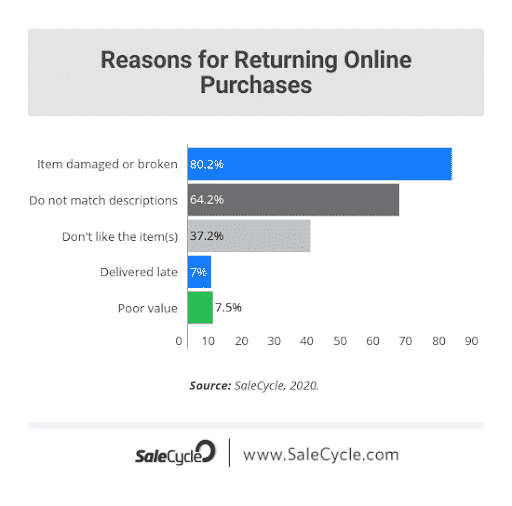
Around 80% of returns were the result of a damaged or broken product, and 7.5% were from a delay in delivery. These are controllable returns showcasing issues with your fulfillment process, which can be addressed through better packaging, better care, or a better third-party fulfillment provider.
Next, we see 64% of returns were the result of a mismatch between product and description. This is also a controllable return highlighting the need for better online product images or descriptions, or an updated sizing chart for clothes and shoes, to more accurately present the product. In fact, many clothing and footwear companies have minimized product returns by employing a “size and fit” specialist, contactable via phone or chat boxes on the company website.
The last controllable return we see making up 7.5% is poor value, which can either be addressed through your manufacturing process or marketing strategy.
The remaining factor is that the customer just didn’t like the product. This is an uncontrollable factor in some respects, in that it could have been a gift or perhaps the customer had a change of heart; but on the other hand, this could even be broken down into smaller factors — some of them controllable. Why didn’t the customer like it?
Finding the answer to the above question is where a well-designed return process needs to come in. Among other things, your company must ensure that all necessary data points are collected throughout the return process in order to further improve your return rates… which brings us to step 3.
According to MIT Sloan, an efficient reverse logistics strategy has the potential of reducing processing costs by up to 50% or more. For that reason, companies that have a systematic approach to handling returns hold a massive competitive advantage over those companies that treat returns in an ad-hoc way, and major corporations hire departments specifically dedicated to handling returns and optimizing the return process.
At a high level, every return process has the following steps: Receive, Sort, Analyze, Decide, Execute. The retailer receives the returned product, sorts it based on certain factors like reason for return, analyzes its condition, decides what to do with it, then executes on that decision whether it is restocked, refurbished or scrapped.
What are your options when you get a return? Creating proper decision trees (IF, THENs) with clear conditions stemming from your return policy gives your company a roadmap to processing returns. This could have many different variations and nuances per your specific business, but as an example it could look like the below:
For refurbished products, find other channels to sell your returned items. The loss margins on returns can be minimized through effective and creative measures like selling refurbished goods in other regions or to different markets.
Pretty straightforward but until recently, the return process has been an extremely labor-intensive endeavor, from sorting to analyzing to deciding, thereby requiring loads of labor hours to process just one return. The answer to this sticky situation just so happens to be what an Australian calls his car.
But seriously, automation is the key. Retailers have found enormous success automating as much of the process as they can, while making the process self-serve for the customer. From the printing of return labels to the issuance of credit, companies that automate the process see large boosts in efficiency and cost-savings. According to Returnly, during a return process, customers expect, at a minimum, to be able to:
This may require having a dedicated portal for refunds. And if you’ve made the necessary decisions upfront, these can be automated as well, further reducing your processing costs and allowing your return team to focus on any extenuating circumstances.
Along with automation comes data aggregation. Knowing why your customer returned the product along with other data points can paint a very clear picture on your reverse logistics landscape, allowing your company to address the various pain points and reduce your return rates.
This, among many other reasons, is why ShipHero has partnered with Returnly to automate the return process for any 3PL or retailer using the ShipHero platform, thereby minimizing human touches, improving accuracy, and reducing costs and errors in the return process, all while keeping the merchant updated in real-time.
This leads to faster returns processing time, faster issuance of refunds to the customer, and faster restocking or resale of the returned goods. Everybody wins, mate.
Processing returns necessitates much more than a part-time effort. Using a third-party provider to process your returns is a good solution if your company lacks the time, resources or know-how to process returns, or if you have a low amount of returns.
Because some specialize in processing product returns, third-party providers can perform product returns quickly and accurately, often through the use of industry-leading software solutions, thereby lowering costs and increasing revenue.
Also, if your company does not have dedicated personnel or procedures for handling product returns, you consider instituting a third-party to improve the process by delivering state-of-the-art inventory management solutions and data aggregation capabilities.
In summary, to handle the growing impact that returns have on your business, it is important to have a clear and generous return policy that fits your business needs, to consistently find and address the causes for returns, and to optimize your return process through automation or outsourcing.
ShipHero is proud to announce our partnership with Returnly to help empower retailers and 3PLs using the ShipHero platform to take control of their product return process.
And to help you successfully navigate the upcoming return season, we’ve secured our customers access to an exclusive deal — two months free when you sign-up for a Returnly Premium plan before January 31st.
We recently teamed up with Andreea Matei at Launch Grow Joy to explain the different order fulfillment models that ecommerce businesses can utilize.Option 1: In-houseStoring the inventory, picking, packing, shipping, all done by your company.To DIY, you’ll need space to house your inventory, and efficient processes to handle orders and ship in a timely manner, not to mention a process for handling returns. Overhead costs are high to house inventory yourself, but this rewards your business full autonomy.Option 2: Outsource to a third partyHand your inventory over to 3PL and smart fulfillment companies like ShipHero who invest heavily in infrastructure and software to create global networks of warehouses and to provide a wide array of cutting-edge fulfillment capabilities.Option 3: Dropshipping (goods ship directly from the manufacturer)Dropshipping is when the manufacturer ships directly to the consumer, completely bypassing the retailer. This is typically used by businesses that are just starting that don’t have the capital for inventory, so the price to start a business is low.When it comes to each option, there are pros and cons that store owners must consider.Read the full article to learn more about choosing the right fulfillment model for your business.A big shoutout to Andreea and her team! She is an expert at increasing publicity and helping ecommerce store owners grow their sales. You can learn more about Launch Grow Joy here.




.svg)