
.svg)

Unloading a shipping container isn’t quite as easy as unpacking your trunk. Watch this video of Alex with ShipHero and Black Wolf Nation Skin Care to find out how you can be more efficient unloading containers at your warehouse.
So, today is a really exciting day. We finally got the first shipment of our brand new product. We launched it on Friday, and sales are crazy. So this is just in time inventory at its finest. We're unloading the container. And today we're also going to be immediately shipping the orders that came in over the weekend. My name is Alex Lewkowict.
I'm the co-founder and COO of Black Wolf Nation.com, a leading men's skincare brand. Our warehouse for Black Wolf has expanded to a 3PL and we fulfill for other top eCommerce brands. Excitingly, our warehouse has since joined the ShipHero network. Today we're doing a live unload. So the truck came this morning, and from the moment that we cut the bolt on the truck, we have 2 hours to unload it.
If the container comes palletized, it's exactly like unloading a semi truck. But today, and like most of our containers, this is called floor loaded. There's no pallets. Every box is stacked on the floor. So these have to be hand unloaded hand palletized, received and put into inventory. And we only have a very short time to do it. So the most basic tool that you need are pallets, pallet jack and a couple of guys.
You can load a container with just that. But it takes a long time. So it pays to get some better equipment to help out with the process. Today, we're going to show you kind of an evolution of how we can do it with very little equipment until we have the full suite of equipment. First step when you get a container is cutting the bolt.
Once you cut it, we're going to open the container doors and then back it up to the dock so that we don't have the doors obstructing. And regardless of method of unloading, the first few pallets, the first few feet of the container, it's most efficient to just build the pallets right on the dock because you're so close to the goods.
Once you get further into the container, that's where you can really build efficiency as you get space in the container enough to turn a pallet around. You're going to want to build the pallets in the container right next to the wall of product, wrap it and then pull it off with a pallet jack. A forklift makes it a lot easier to unload.
What you do with the forklift is you build the pallet inside, turn it around in the container, drop it on the edge, and then you can have your forklift operator pick it off the container. So the other way to get goods from the back of the container to the dock is with the conveyor belt. Most containers that come are 40 feet long.
So bringing goods by hand, 40 feet takes a lot of time. So if you don't have a forklift, you're not ready for one. A good investment if you're going to get a couple of containers a month is a conveyor belt. We use just a simple gravity expandable conveyor belt. So as we get further and further into the truck, we stretch it out.
So you're going to have one or two guys in the container putting cases on the belt, and then you'll have your dock guys taking the goods off the edge of the conveyor and palletizing it. That way you eliminate all the walking, which is what tires the guys out and takes a lot of time. The last way to unload a container is if you have the next level up of equipment. Some warehouses will have motorized conveyors that expand into the truck as you get further and further down And then some of our other warehouses, like our warehouse in Jacksonville, have specialized forklifts that can actually unload floor loaded containers with slip sheets, which is basically a thin piece of cardboard that the factory puts under the goods. Doesn't take up a lot of space. And it's a special attachment on the forklift where the forklift can drive in pick up a pallets worth of goods and drive it out.
You can unload a container in 15, 20 minutes that way. The most important thing to consider with a live unload is the time limit. If you go over your time limit, whether it's an hour or 2 hours, you get charged penalties that can be quite expensive. So it's better to hire extra people to help unload the container than incur an extra hour of time.
Planning is key. Make sure that you communicate with the delivery company and you have a set delivery appointment and make sure that you have guys on hand with proper footwear, pallets ready, wrap ready, and that you're ready to go. When that container door opens, the clock starts and that's action time and you got to get it done.
.webp)
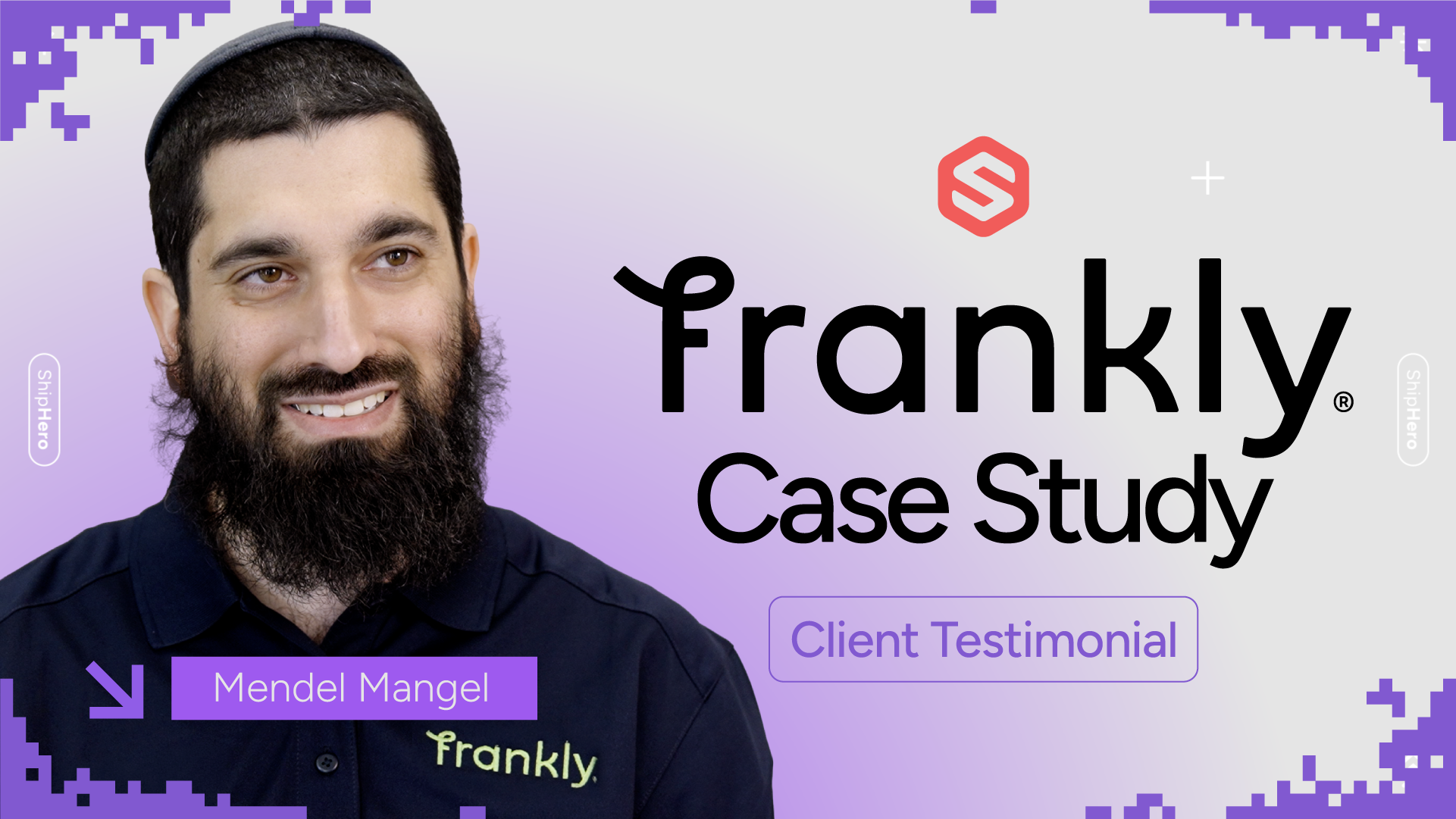
When CEO Mendel Mangel founded Frankly Fulfillment, he initially viewed ShipHero as a competitor. But after struggling with a legacy WMS that “nickeled and dimed” every step of their growth, he realized that ShipHero’s operator-first background was actually an “astronomical benefit”.In this interview, Mendel shares how making the switch helped them scale from near zero to 65,000 orders a month while eliminating customer churn due to operational errors. He also details how the team utilizes RateShop+ to balance shipping speed against costs, ensuring efficient delivery without sacrificing margins.Watch the video to see how they stopped worrying about software limitations and focused entirely on scaling.
.svg)

"ShipHero is the Apple of shipping software." Join us behind the scenes with Mitch Mammoser, COO and Co-Founder of Frost Buddy, to see how they managed a "rocket ship" growth trajectory to nearly $80 million in sales. In this case study, discover how Frost Buddy utilized ShipHero to navigate the challenges of rapid scaling and high-volume fulfillment. Follow their journey to discover:
Watch the full story to see why ShipHero is a "non-negotiable" partner for one of the world's fastest-growing drinkware brands.

Meet the Packer Performance Dashboard, ShipHero’s latest feature that goes beyond simple pack rates.
📦 Tracks key packing events (Tote Scan, Item Scan, Print Label, Order Complete)
📈 Scores efficiency based on expected vs. actual pack time
⚡ Factors in order complexity & shipment type for real-world accuracy
Your warehouse just got smarter. Ready to optimize labor costs?
.svg)
.jpg)



.svg)