.svg)

What is Revenue per Visit? And, how our best warehouse management software can help you fulfill all those new orders. The trinity to e-commerce digital marketing excellence lies in three metrics: Average Order Value (AOV), Conversion Rate (CR), and Revenue per Visit (RPV). In this series, we will introduce how these
.svg)
The trinity to e-commerce digital marketing excellence lies in three metrics: Average Order Value (AOV), Conversion Rate (CR), and Revenue per Visit (RPV).
In this series, we will introduce how these metrics are gathered, how they impact your business, and how to improve each.In this first part, we will discuss Revenue per Visit.
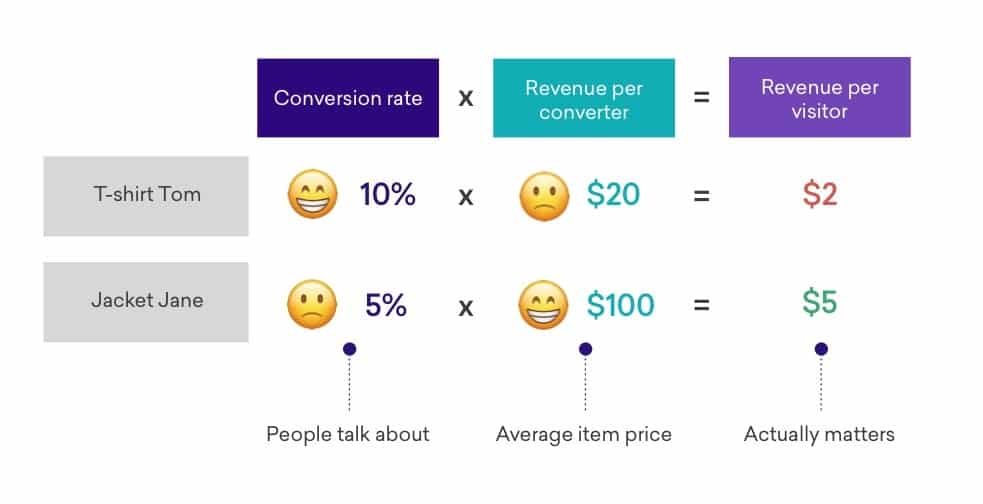
Revenue per Visit (RPV) is calculated as Total Revenue ($) divided by the Number of Visitors (#)
RPV is also calculated as Average Order Value ($) multiplied by Conversion Rate (%)
Revenue per Visitor and Your Business
Revenue per Visitor basically translates to: how much money does my business make for every person that visits my website.
RPV also allows you to gauge your new visitor acquisition efforts: are you attracting the right kind of visitor?
Notice it says visitor, not visit. The RPV metric does not use the total number of visits to your site in its calculations; rather, it counts only unique visitors, with each individual person counting as one visitor.
Revenue per Visitor (RPV) as a metric carries an important distinction from Average Order Value (AOV) and Conversion Rate (CR) -- discussed in our AOV and CR blogs. WIth AOV and CR metrics, you are able to set targets, a desired number or percentage to achieve. For RPV, the importance lies in how the metric is trending, whether upwards or downwards.
RPV allows you to measure and determine your budget for spending on user acquisition, such as your advertising budget.
Let’s look at how to calculate RPV, and show the implications it can make for your business. Consider the following scenario:
Example 1
Example 2
In both examples, it is apparent that Company B is attracting higher-quality and more qualified customers than Company A. Company B is also spending half of what Company A does in customer acquisition.
So, improving RPV could be the competitive advantage you need to succeed. Ready to start climbing?
If you want to start on the path towards positively increasing your PRV, you need to start attracting the right customers to your site and providing them with the best experience. Here are the Top 3 Proven ways to do just that:
Attracting the right customer to your website is the best way to improve your RPV. Now, who are the right customers?
The right customers are those specific website visitors that are more likely to convert and hopefully contribute towards a higher Average Order Value (AOV). Oftentimes these are referred to as ‘qualified’ customers. These customers also have growth potential for their lifetime value -- calculating Customer Lifetime Value is a great way to understand who the right customers are.
In analyzing your customer base of those that successfully converted, what common factors did they share if any? Any demographic or location similarities? Did they look at the same products? Did they check your ‘About Us’ page or Company Mission statement before converting?
Questions like these are what Data Analytics departments strive to answer, and it is the basis for your ecommerce business to take a data-driven and targeted approach towards marketing your business and finding the high-value customers or customers with a potentially large lifetime value. You should focus on retaining valuable customers, and getting rid of the rest.After you identify and attract the right customers to your website, what’s next?
As discussed in our past blog about AOV, providing product recommendations, and upselling or cross-selling complementary products along the customer journey is an effective method to increase AOV.
To recap, the strategies to increase AOV are:
Product recommendations
Set order minimumsIncrease prices
Upselling
Cross-selling
Urgency and Scarcity
Reward Programs
As discussed in our blog about Conversion Rates (CR), you must think about your customer journey from landing page to purchase confirmation. Each step in this process needs to be streamlined to reduce friction and increase your conversion rates.
To recap, the strategies to increase CR are:
Adding pop-ups
Simplify the first step
Chat boxes
Reduce form fields
Eliminate noise and distractions
Retargeting and remarketing
The above three methods are the top three proven ways to increase your company’s RPV.
Identify and market to your high-value customers
Sell more product per transaction and Improve the average order value (AOV)
Optimize the customer experience and improve conversion rate (CR)
This is the first part of our 3-part blog series covering essential e-commerce metrics: RPV, AOV, and CR. We hope you have a better grasp of how to measure the success of your e-commerce business. We'll cover AOV and CR in future posts.
The beauty of your ecommerce company is that it can be easily measured and optimized; all you have to know is what to look for and how to turn the dials. Check back here to learn more about other metrics and tools of the trade.
And, if your warehouse is getting a surge of volume, we can help. We believe we have the best warehouse management software on the market. It will make your warehouse run like a finely-tuned Swiss watch, with great efficiency and minimal mistakes.
.webp)
Explore the top 3PL companies in Canada and learn how third-party logistics providers play a vital role in optimizing supply chains. Discover the benefits of partnering with a 3PL, key services offered, and steps to start working with a 3PL in Canada.
.svg)
Discover the top 5 best third-party logistics (3PL) companies for your business needs, offering extensive networks, advanced technology, and superior customer service. Learn about the benefits of 3PL services, how to choose the right provider, and avoid common mistakes.
Discover the role, benefits, key features, requirements, and implementation of a 3PL Warehouse Management System (WMS) for optimizing warehouse operations. Learn about scalability, integration, real-time visibility, and customization options to choose the best solution for your business.

At the denser wall, average picking time per order fell from 40 seconds to 13, and orders that ran clean from start to finish rose from 18% to 97%. This is the companion to our Direct Pack + Pack-to-Light case study, from the same research.





.svg)



.webp)