
.svg)

.webp)
.svg)
Through a new integration with Google Merchant Center, ShipHero will help our businesses drive more conversions on Google channels by showing customers more accurate, location- and product-specific delivery speed estimates. All that our businesses need to do in order to take advantage of this feature is to link to their ShipHero account in Merchant Center. It’s really that easy!Shipping speed can play a critical role throughout the purchase journey, from discovery through final purchase:
By linking accounts, ShipHero businesses can showcase their investment in fulfillment capabilities to customers on Google across a wide variety of user experiences and journey stages. Moreover, participating ShipHero businesses should find it easier to obtain annotations that drive traffic and conversions, such as the free and fast shipping annotation.
When a ShipHero business links their account, recent order tracking data is sent from ShipHero to Google, who then feeds that data into machine learning models to generate delivery speed estimates. On Google channels, customers will see delivery estimates based to the item they are viewing and their current location, among other factors. For example, if an item is fulfilled out of a facility in Pennsylvania, a shopper in Maine might see a 2-day delivery speed, while one in California sees a 5-day delivery speed.
Today, most businesses configure a nationwide shipping speed on Google, leading to customers’ seeing an overly conservative delivery speed that accounts for even the most remote locations. By using this approach, we expect most ShipHero businesses will be able to quote lower and more accurate delivery speeds to customers, based on the performance of similar Google-calculated shipping programs. And, given how critical delivery speed is to customers’ purchase decisions, an improvement in quoted speed should yield more conversions.
For now, the ShipHero-powered delivery speeds on Google are only available for orders originating from and delivering to the United States. Furthermore, the ShipHero-powered speeds work for channels managed by Google Merchant Center (link), including Shopping ads (link), free product listings (link), and Buy on Google (link).
1. To link your account, you will first need your ShipHero username and password. If you don’t know these, please reach out to ShipHero Support.
2A. If you already have shipping speed configured on Google Merchant Center, all you need to do is set up ShipHero for shipping data verification by linking your accounts here. - or -
2B. If you do not have shipping speed configured — e.g., if you use the [shipping] attribute (link) in your product feed to convey shipping cost — you should set up an account-level, ShipHero-powered shipping service here, by doing the following:
NOTE - If you have used the [shipping] attribute to provide shipping cost, it will override the account-level shipping service you have set up in step 2B. For this new ShipHero service to work, you must clear the [price] sub-attribute within the [shipping] attribute for the items you want Google-calculated shipping speeds to apply to.
NOTE - If you have multiple shipping options configured for the same country, Google will select the cheapest option to show to the customer. If Google finds that, for a given country, you have multiple shipping options that cost the same amount, it will then select the fastest option among them to display. Your ShipHero service from 2B will not display if it does not “win” that “cheapest, then fastest” logic for the United States.
A key benefit of letting Google calculate your shipping speed is that your items on Google will show a delivery speed that varies by region. So, even if you do not offer nation-wide “fast” shipping, Google will understand the areas in the country where your items will arrive “fast.” For example, if you operate 2 well-placed eFCs and use only ground fulfillment, perhaps 60% of the US will receive items “fast” (in 3 days or less).
So, once you have linked your ShipHero account, obtaining the free and fast shipping annotations is pretty straightforward. You just need to meet the other program requirements, which are as follows (more info)
If you don’t yet use Google to connect with customers, you can get started by signing up with Merchant Center here. Since last year, Google has offered a free listings product which may provide you with traffic and sales at no cost. You can learn more about it here.
ShipHero can provide turn-key outsourced fulfillment services or help you manage your own fulfillment network with our advanced Warehouse Management Software. If you’re new to ShipHero, you can schedule a call with one of our experts to develop a fulfillment solution that works for you and your customers. Click HERE to schedule a meeting today.
You can read more about how Google calculates shipping speeds here and shipping data verification here. Need help with Google topics? Reach out to Google Support.
Be sure to follow ShipHero on Twitter&LinkedIn today to stay up to date with the latest company news.
.webp)

Inventory accuracy is more than just knowing what’s on your shelves. Too much stock can tie up valuable capital and may even increase storage costs. Too little, and you risk stockouts that delay orders, which will frustrate customers and harm your reputation. If you're struggling with stock discrepancies or fulfillment delays, an inventory audit is your first line of defense. For eCommerce businesses, especially those scaling across multiple warehouses, a clear and repeatable inventory audit checklist ensures accuracy and improves efficiency at every turn.
An inventory audit checklist is a structured document that standardizes procedures for reviewing stock levels and validating inventory records. It outlines every step needed to verify physical inventory against digital records, such as what’s stored in a warehouse management system like ShipHero.If you want to learn how to audit your warehouse, this checklist provides consistency, accountability, and a streamlined flow from receiving inventory to reconciliation.Common Checklist Formats
If you’re building your own warehouse audit checklist, start by deciding which format suits your audit cadence, staff size, and inventory complexity.
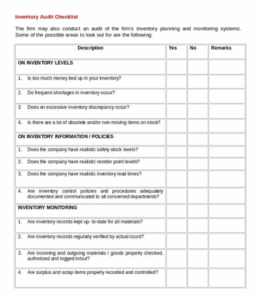
Simple Inventory Audit ChecklistThis checklist uses a basic yes/no format to evaluate the general health of inventory across three sections: inventory levels, policies, and monitoring. It's quick to complete and ideal for identifying broad issues, such as shortages or outdated stock.
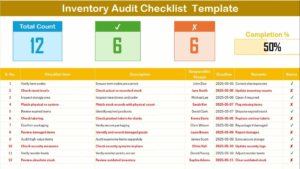
Detailed Inventory Audit ChecklistThis version includes specific checklist items, responsible personnel, deadlines, remarks, and status updates. This offers more visibility and control. It tracks task progress, assigns accountability, and helps teams follow through on corrections.
The effectiveness of any inventory audit hinges on what you track. A well-structured inventory audit checklist builds clarity into every step of your stock review process. Including the right fields uncovers discrepancies faster and supports consistent performance across every audit cycle. Here’s a list of what to include:
A robust audit strategy uses multiple methods. Each one adds a layer of verification, giving you the best chance to identify discrepancies, confirm stock accuracy, and audit systematically.
ACB analysis identifies cost drivers (e.g., storage, handling) in inventory by mapping the impact of each inventory activity on the budget. This helps you identify areas where you're overspending and find ways to reduce costs without compromising quality.
This uses ratio checks (e.g., sales-to-stock ratios) and trend reviews (e.g., seasonal stock fluctuations) to quickly identify anomalies or potential fraud. This assesses inventory levels based on performance and reveals deeper insights into shrinkage or miscounts.
A physical inventory count is exactly what it sounds like. Your team goes through your warehouse item by item, scanning barcodes or manually tallying products, and then compares these real-world counts to your digital records.
This procedure examines stock transactions around period-end (e.g., the end of the month) to confirm that all purchases and sales are recorded in the correct period. This verifies compliance with accounting standards and avoids overstatement or understatement.
Instead of a single annual audit, a cycle count breaks audits into daily or weekly rotations by product category, keeping records more accurate throughout the year. This method is ideal for companies using ShipHero’s warehouse receiving process checklist to avoid full shutdowns.
Compare the numbers: system records vs. physical stock. Investigate any mismatches and specify the reasons to update the documentation accurately.
Examine if freight costs align with inventory valuation. Spot inconsistencies that could point to vendor overbilling or recordkeeping errors.
Distribute warehouse costs (utilities, rent, labor) to inventory items. This reveals the full carrying costs, supports more accurate pricing and replenishment decisions.
ShipHero’s Automated Inventory Management System simplifies inventory audits by providing real-time data and seamless tracking of stock levels. With advanced features like cycle counting, barcode scanning, and automated reconciliation, ShipHero ensures accuracy and reduces manual errors. The system generates real-time audit reports, making it easy to identify discrepancies and maintain inventory accuracy. By automating these processes, ShipHero streamlines your inventory audits, saving time and improving efficiency across your warehouse operations.
Failing an inventory audit can lead to financial losses due to undetected shrinkage, stockouts, or overstocking scenarios. It may even create compliance issues if financial statements or regulatory submissions rely on inaccurate information.
Inventory managers, warehouse leads, or internal auditors typically oversee the checklist. Their role is to ensure the process is followed, issues are documented, and outcomes are reviewed.
They aren’t always legally required, but are considered best practice. They are critical for maintaining operational control and financial accuracy.
.svg)
The logistics and supply chain industry is rapidly evolving, with AI improving warehouse efficiency by automating tasks and streamlining operations. AI is transforming logistics by enabling smarter decisions, reducing costs, and enhancing service quality. In this article, we delve into the top 10 ways AI is transforming logistics and helping businesses stay ahead. Continue reading to discover how AI is revolutionizing the world of logistics and supply chain management.
AI enhances operational efficiency in logistics by automating tasks, reducing errors, and streamlining workflows. ShipHero’s AI automates picking processes, speeding up product selection and improving fulfillment accuracy. It also forecasts demand and adjusts stock levels to enhance inventory accuracy.AI-driven route optimization enables logistics companies to find the most efficient delivery paths, saving time and reducing fuel costs, which in turn facilitates faster decision-making and improved resource management. Discover cutting-edge technologies that shape the future of logistics through this Futuristic Logistics: Emerging Tech article.
In logistics, AI drives down overhead costs by enhancing shipment tracking, order processing, and warehouse management. AI reduces manual errors and integrates with warehouse management systems to help improve storage efficiency. Amazon has leveraged AI for cost-saving automation in its warehouses, reducing operational expenses and demonstrating the long-term profitability of AI in logistics.
AI improves delivery speed and accuracy through real-time monitoring of stock levels and vehicle movements. Additionally, ShipHero’s AI picking technology ensures quick, precise product selection, which minimizes errors and delays. Smarter routing then reduces delivery times and fuel consumption, enhancing customer satisfaction and loyalty.
AI forecasts demand patterns by analyzing historical data, helping companies predict stock needs and avoid overstocking or stockouts. It can also predict seasonal fluctuations and adjust inventory levels, ensuring smooth operations, especially during peak seasons, and minimizing disruptions.
Real-time tracking, powered by AI, enables logistics companies to monitor shipments, inventory, and vehicles 24/7. AI enables businesses to gain visibility across the entire supply chain and optimize inbound and outbound logistics for smoother operations.For example, AI picking technology ensures accurate order fulfillment by streamlining product selection to improve tracking efficiency and delivery processes. This integration enhances overall operational effectiveness.
AI-driven warehouse automation reduces labor costs, boosts efficiency, and speeds up turnaround times in logistics. Automated guided vehicles (AGVs) and robotic picking systems are being increasingly used to expedite the picking and packing processes. ShipHero’s AI picking technology, for instance, enhances the accuracy and speed of product selection, which further improves the efficiency of warehouse operations. By controlling robotic systems with greater precision and at faster speeds, businesses can process higher volumes of orders more efficiently.
By leveraging real-time data, AI-powered route optimization determines the most efficient delivery paths to reduce fuel usage and delivery time. Companies like UPS have seen cost savings, improved delivery efficiency, and a reduced environmental impact by using AI.
AI transforms customer service by enabling quicker response times, accurate details, and personalized experiences. With AI automating basic inquiries, support teams can focus on more complex tasks and enhance efficiency to ensure timely delivery and accurate fulfillment.
AI is transforming inventory management by providing real-time tracking, predicting stock needs, and preventing waste. It reduces manual errors and ensures stock levels align with demand. ShipHero’s AI picking systems, for example, improve inventory accuracy by automating the product selection process, which leads to faster, more precise fulfillment. Additionally, AI integrates with warehouse management systems to update inventory as products are picked, packed, and shipped, ensuring accurate records and improved resource management.
AI helps logistics companies enhance supply chain resilience by anticipating disruptions and offering alternative solutions. Whether due to weather, strikes, or shortages, AI enables quick adaptation by identifying backup routes or alternative suppliers, ensuring smooth operations and long-term resilience.
AI has proven to be beneficial for multiple industries; from saving time to reducing costs, there's a lot it has to offer. That being said, it still comes with its own set of challenges that many businesses encounter when attempting to integrate new systems. Let’s dive into some common challenges you may encounter:
However, the good news is that these challenges are manageable if approached correctly:
Scalable AI Solutions with ShipHeroAs your business grows, it’s crucial to choose tools that can grow with you. That’s where scalability comes in. You need systems that evolve as your operations expand. ShipHero’s warehouse management system (WMS) is designed to do just that. Whether you're a small operation or handling high volumes, ShipHero adapts to your needs. With real-time inventory tracking, automated workflows, and easy integration, it grows alongside your business. Additionally, ShipHero provides the training and support your team needs for a seamless transition, making it a flexible and long-term solution for your warehouse operations.
When choosing AI tools for logistics, businesses should consider scalability, integration, and cost. AI tools like ShipHero streamline warehouse automation, while others focus on route optimization or demand forecasting.Choosing an AI system that aligns with specific business needs is critical to maximizing return on investment (ROI). Additionally, conducting trial periods and ensuring adequate vendor support can help businesses find the right fit for their logistics operations.
The ROI of AI in logistics depends on efficiency, cost savings, and customer satisfaction. Businesses typically experience a significant return in terms of reduced overhead costs and improved operational efficiency, resulting in greater profitability.
AI technologies like machine learning, predictive analytics, computer vision, and robotics are transforming logistics by automating tasks and improving decision-making in areas such as inventory management, route optimization, and customer service.
Yes, the initial cost of implementing AI in logistics can get expensive, but the long-term savings from enhanced efficiency and reduced labor costs far outweigh this. AI-driven systems streamline operations that drive significant cost reductions and boost profitability over time.
No. AI improves warehouse efficiency without replacing human roles as it automates repetitive tasks to allow humans to focus on strategic decisions and problem-solving.
No, AI solutions are accessible for businesses of all sizes. Scalable solutions like ShipHero can help small to medium-sized logistics companies achieve similar benefits as larger enterprises.
Expansion of Existing Partnership Enables Brands Using ShipHero
to Ship Using Veho Directly From Their Own Facilities
New York, NY, January 7, 2025 – Veho, the tech company that’s become one of the largest delivery networks in America, and ShipHero, the leading shipping and logistics platform, today announced that ShipHero’s more than 5,000 e-commerce brands and third-party logistics providers (3PLs) can now ship their parcels through Veho out of their own distribution centers.
This is an expansion of an existing, nearly three-year partnership during which ShipHero clients could only leverage Veho for parcels fulfilled by ShipHero itself. All of ShipHero’s WMS clients can now take advantage of Veho’s premium delivery services.
The expansion of this partnership is noteworthy because ShipHero is one of the most popular warehouse management system platforms for businesses to ship their products, while Veho is now one of the largest delivery providers in America.
Veho’s tech-enabled, premium delivery experience enables brands to offer 2-3 day delivery across 44 markets covering 105 million Americans, delivery seven days per week, as well as industry-leading 99% on-time delivery and 4.9 out of 5 stars customer satisfaction score. Veho’s approach has the potential to reduce shipping-related costs by approximately 35% while increasing customer lifetime value by 51%, enabling brands to gain a return on their shipping spend.
“Thousands of e-commerce companies rely on ShipHero for fulfillment and warehouse management, so Veho is proud that those brands will be able to provide their customers Veho’s fast delivery and elevated experience directly from their own warehouses going forward,” said Veho CEO Itamar Zur. “By combining customer obsession, the latest technology, and operational expertise, Veho provides a delivery experience that customers rave about and is proven to reduce shipping costs, as well as increase customer value. We’re eager to show ShipHero and its clients what Veho can do for their business.”
ShipHero was founded in 2013 to create a fully comprehensive Warehouse Management Software for e-commerce brands and 3PLs. Now, ShipHero is a complete Warehouse Operating System that powers high-performing warehouses and enables growth at scale for its clients. Part of ShipHero’s added value is creating and maintaining strong partnerships with key players in DTC fulfillment, including Veho.
“Veho’s technology-driven approach and unwavering commitment to customer satisfaction perfectly align with ShipHero’s mission to revolutionize e-commerce,” said Aaron Rubin, CEO at ShipHero. “This expanded partnership enables us to offer our customers a more comprehensive suite of solutions, empowering them to exceed customer expectations and achieve sustained growth in peak season and beyond.”
Veho’s technology platform and delivery network enable some of America’s leading retail and e-commerce brands to get packages to customers faster and better than legacy carriers. Veho allows consumers to control when, where, and how their packages are delivered, provide specific delivery instructions, communicate with their delivery driver-partner, and use GPS, AI, and machine learning to ensure packages are delivered as consumers expect, and every delivery is better than the last.
Veho is a next-generation delivery platform, turning shipping from a cost center into a value driver. By combining purpose-built technology, customer experience obsession, and a scalable delivery network, Veho enables brands to offer an Amazon-level delivery experience that measurably improves their bottom line. The industry-leading results speak for themselves: 99% on-time delivery, 4.9/5 customer satisfaction score, 71% fewer delivery-related refunds, and a 41% increase in customer lifetime value. Now one of America’s largest delivery platforms, Veho serves 105 million Americans across 44 markets–and growing. Learn why leading brands, including Sephora, Zara, Lululemon, Saks, and Macy’s, trust Veho to drive a return on their delivery experience at shipveho.com
ShipHero is a US-based provider of cloud-based e-commerce fulfillment solutions that give online retailers and third-party logistics providers the tools to ship more efficiently anywhere in the world. With more than 5,000 customers located around the globe, ShipHero robust Warehouse Management System (WMS) allows them to truly understand their complete costs and use the data to make informed, cost-effective decisions. Some notable customers include Universal Music Group, Hush, and Canadian Tire. Additionally, 10% of all Shopify+ orders globally are processed through ShipHero.
Media Contacts:
Veho: Evan Wagner, Evan.Wagner@shipveho.com or veho@escalatepr.com
ShipHero: Megan Sullivan, megan.sullivan@shiphero.com or media@shiphero.com



.svg)



.webp)