
.svg)

A complete guide to warehouse management systems: what they do, why they matter, the different WMS types, and how to choose the right one for your business.
.svg)
A warehouse management system improves your eCommerce business by helping your team pick, pack and ship more items faster. It also provides real-time visibility into your supply chain to give you a full picture at any moment.If you want to learn more about warehouse management systems, you’ve come to the right place. Read on for a complete guide on warehouse management systems in 2023.
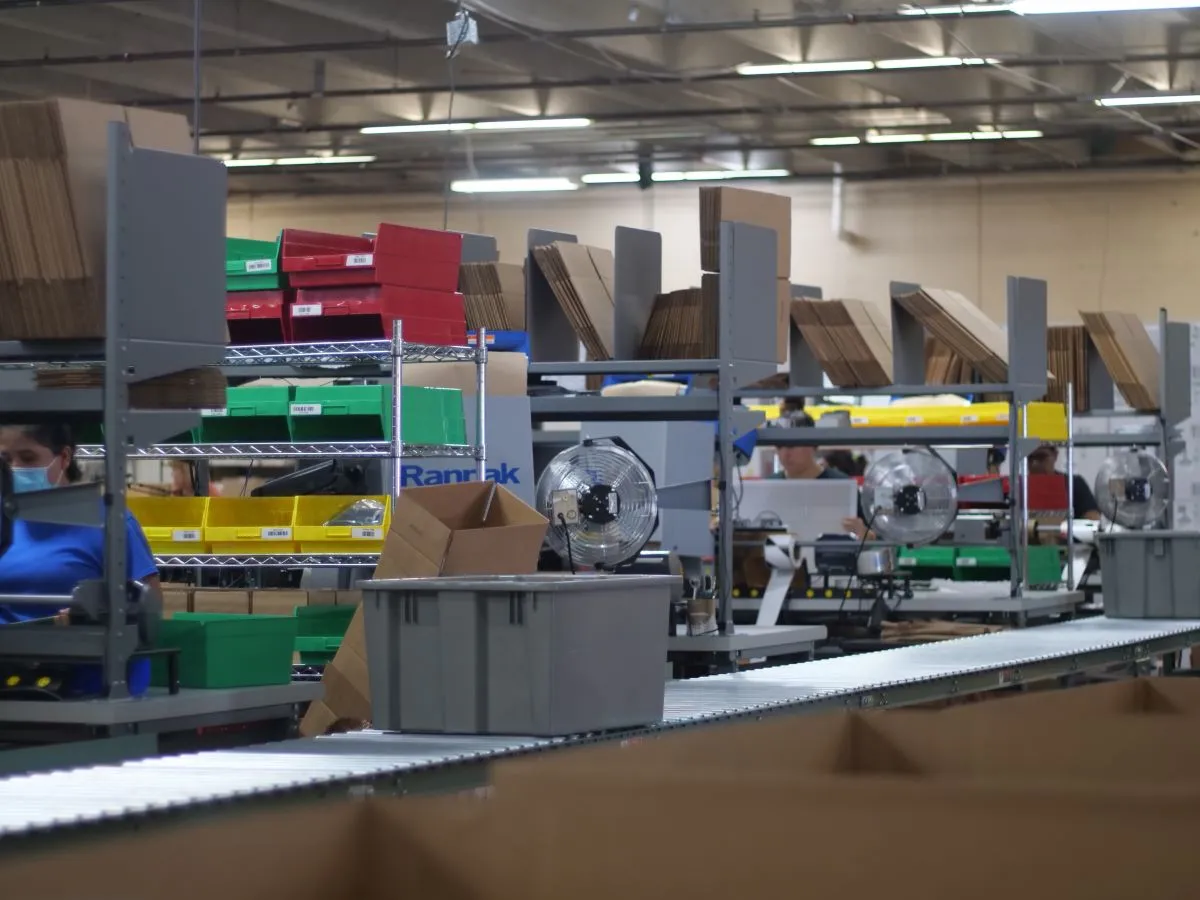
Warehouse management is the process of overseeing all operations and activities in a warehouse. This generally includes receiving, picking, packing and shipping goods, planning workloads, training staff and handling customer returns.While warehouse management is barely visible to customers, it’s integral to ensure goods are delivered on time. Good warehouse management ensures every activity is run as efficiently as possible, from maximizing inventory storage to organizing goods for easy picking to ensuring returns are handled professionally.However, running a warehouse can be costly, especially for smaller eCommerce businesses. Instead of managing their own warehouses, they sometimes hire third-party logistics (3PL) companies. Outsourcing warehouse operations helps eCommerce businesses focus on expansion and sales instead of spending considerable time and resources to manage inventory and take customer orders.
A warehouse management system (WMS) is software that assists you in the warehouse management process. A warehouse management system gives you real-time updates on your inventory levels, warehouse team productivity and order fulfillment progress.Warehouse management systems are essential for managers because they can use them to gauge work performance and spot improvement areas. They also provide managers with the data and reports to make informed business decisions.The best warehouse management systems assist your company with five key processes:
One of the primary purposes of a warehouse is to receive and store inventory items from a manufacturer or distributor. Warehouse management systems let you scan and organize each new item upon arrival and storage, so you’ll know which items have arrived and where they're stored.
Inventory tracking ensures you get real-time updates on your stock levels. This helps in determining how many items you can sell and whether you should order more items based on accurate forecasts of consumer demand.As your eCommerce business grows, inventory tracking will become even more important because you may handle hundreds of goods and dozens of different product types simultaneously. Manual inventory tracking is more prone to human error and may result in costly mistakes.
When employees pick and pack items, they take the goods from warehouse shelves and pack them for shipping. Warehouse management systems can generate picking lists that instruct your warehouse team to pick items as efficiently as possible.Your warehouse management system also automatically generates shipping labels, which packers attach to products after packing them.
Warehouse management solutions let you track the shipping progress in real time. You can also show the shipping progress to customers so they know where their items are at any time.
Your warehouse management system should provide advanced reporting features that cover order fulfillment accuracy, staff inventory forecasting and warehouse expenses. Automating report creation means you don’t have to spend much time gathering data. Instead, you can immediately use the insights from these reports to improve your warehouse operations.
Warehouse management systems are useful for any company that operates a warehouse, regardless of industry. Here are examples of industries that can benefit greatly from WMS:
Manufacturers need to have good warehouse management systems because they have complicated warehouse operations that may involve combining multiple materials into new goods.A WMS can help manufacturers track each material as they’re sent in for processing and alert the staff to reorder when stocks are running low to keep production running. The system can also regulate production line speed based on consumer demand forecasts, preventing overstock or understock.
Managing a retail chain is challenging because you operate multiple stock rooms in each store. A warehouse management system helps retail business managers by tracking items as they move from your main warehouse to individual stores. It also monitors stock levels in each store and puts orders in whenever an item is running low in stock.
Food and beverage warehousing is trickier than most because products often need to be stored at specific temperatures and have expiration dates. A WMS for F&B manages shelf placement to ensure everything is stored in its appropriate places. It also regulates picking and packing to guarantee all items shipped don’t expire before they reach store shelves.
Warehouse management is at the core of every third-party logistics company, and they need a warehouse management system to excel in their job. Many 3PLs use adaptable warehouse management software to meet the various demands of their clients and juggle multiple warehouse operations simultaneously.Some third-party logistics companies even choose a baseline warehouse management system and develop their own modules according to their needs, creating client-specific dashboards tailored to every job.
You should use a WMS because manual warehouse management is prone to human error, especially if you run a large eCommerce business.Here are five other reasons why you should use a WMS:
Warehouse management systems improve your inventory management by monitoring its levels, increasing pick and pack efficiency and improving order fulfillment processes. By automating these various inventory management processes, you’ll get all the information needed to run your warehouse smoothly without spending precious time asking around or looking for data.
While customers don’t directly interact with your warehouse, it plays a big part in their satisfaction. Smooth warehouse operations with the help of a WMS means customers receive orders quickly and accurately. Even if their item is defective, a good WMS can help you handle product returns to ensure customers get their replacement goods quickly.
The right warehouse management software improves your sales and order processing speed without adding new warehouse staff. This means you can process more items and sell more products without a considerable increase in cost, ultimately improving your profit margins.
Warehouse inventory management systems generate reports on essential warehouse performance parameters like order accuracy, orders fulfilled and staff efficiency. By analyzing these reports, your management team can develop plans to improve your eCommerce business further down the road.
In addition to keeping up with customer demand, businesses must also follow local regulations and rules. A good WMS should give you the tools necessary to stay compliant with these regulations by recording real-time data, making your company easier to audit.
Warehouse management systems work by monitoring and automating key warehousing processes. Here’s a look at how warehouse management systems help you in those areas:
Tracking the goods that enter and exit your warehouse is one of the primary functions of a WMS. For incoming items, the WMS will register them in the system and send the products to the appropriate shelf or container for storage.For outgoing items, the WMS will show you which shipping service is delivering the products and provide real-time tracking information. The WMS can also show the tracking information to the customer, so they know when their products will arrive.
A WMS helps you track and manage physical inventory levels in the warehouse. When inventory stock starts to get low, the WMS can notify you to order more from the distributor or supplier before stock runs out.
When a customer order comes in, your warehouse crew picks and packs the items to get them ready for shipping. Warehouse management systems create picklists to help your team pick items faster. The WMS also creates shipping labels, so the items can be ready for shipping as soon as they’re packed.
Real-time warehouse reporting is one of the greatest strengths of a WMS. You can easily get insights into your warehouse's operation by generating real-time reports. Instead of spending hours gathering data, you can immediately use this information to make informed decisions and improve your warehouse team’s performance.
While it may be a considerable investment, a warehouse management system pays for itself in many ways. Here are eight great benefits you’ll get by implementing a WMS:
Inventory control involves managing your warehouse’s inventory levels to prevent understock and overstock. Automating inventory control through a warehouse management system means you don’t have to spend time checking inventory levels regularly. Instead, your system will notify you when it’s time to order new products.
Transparency and traceability are essential for both businesses and customers. Tracking where products are in real-time allows you to identify bottlenecks and delays in the supply chain. On the customer side, real-time product tracking ensures they know when their items are arriving.Some product safety regulations also require your goods to be easily traceable to prevent fraud and counterfeiting. From a safety standpoint, knowing where a product comes from and where it’s going also makes product recalls easier when necessary.
The relationship might not be immediately clear, but a warehouse management system contributes to customer service. Your WMS gives you real-time updates on how many items are in stock and which ones are out of stock, which means customers likely won’t order something that’s out of stock. Warehouse management improvements help you ship products quicker, satisfying your customers’ demands for fast deliveries.
There are many tasks in your warehouses or distribution centers, like picking and packing orders, loading trucks and handling returns. Your WMS can create these tasks and assign them to the relevant employees immediately based on where they are in the warehouse. Your software’s task management features also prevent workers from walking from one end of the warehouse to another when completing their work by assigning them to well-defined work zones, increasing overall warehouse efficiency.
Containerization is when you merge multiple individual shipments into a single container to ship together. You can save on shipping costs by sending multiple items in one big batch. Your WMS assists in containerization by choosing which items go into which container, ensuring they stack well and nothing gets crushed or damaged in transit.
A warehouse management system increases the overall order processing and fulfillment speed by making product picking, packing and shipping more efficient. You can deliver more items to more people by increasing order speed, increasing total revenue and customer satisfaction.
Without a WMS, you may need to create shipping labels manually, which takes a lot of time and effort. A warehouse management system can automatically generate shipping labels, so your warehouse team only needs to attach them to packages before sending them to the carrier.
Labor management features provided by a WMS track your warehouse staff performance in real time, giving you insights into how your team works. Tracking labor lets you identify possible logistics bottlenecks, pinpoint improvement areas and learn which employees may need extra training to succeed.
There are four warehouse management system types, each with unique benefits and drawbacks. Here’s a look at each WMS type:
A standalone warehouse management system is the most basic WMS in this list because it only offers warehouse management features and nothing else. A standalone WMS is usually installed on-premise, meaning the vendor will come to your warehouse and install a physical server for the WMS.Standalone warehouse inventory management software is typically the most affordable due to its limited features, but it may not be enough if you need extra functionality from your WMS. Standalone warehouse management systems are best for businesses without a large software budget and limited warehousing needs.
A cloud-based warehouse management system means the vendor provides its services through the Internet without any physical on-premise installations. Cloud WMS users usually pay a subscription fee to use these services instead of an upfront expense, making them more affordable for new businesses without large premises.Cloud-based WMS is scalable, meaning you can pay for extra accounts and features if necessary. It’s also easier to update since the vendor can do it online. However, as with most cloud-based services, you need a strong and stable Internet connection to make the most out of a cloud-based WMS.
ERP (enterprise resource planning) is a software bundle that merges numerous business functions like accounting, inventory and human resources in one package. It’s a good choice if you want to merge all your company information into one dashboard that’s accessible by all employees.While ERP systems often have a warehousing or inventory management module, it’s not the system’s core functionality. Additionally, implementing ERP is often expensive and time-consuming, so you may be better off implementing dedicated warehouse management software if you can’t commit to full ERP implementation.
Supply chain management systems work at a much broader scope than a WMS but generally still provide warehousing features. These modules work best for companies that work with numerous supply chains, like manufacturers and retail businesses.
Choosing the best WMS means picking the one that caters to all of your warehousing needs at a reasonable price. Here are five tips to help you pick the right WMS for your business.
You should first identify what you need out of warehouse inventory management software. Create a list of feature priorities based on your requirements as a guide when shopping for warehouse management systems. Don’t blindly follow the latest warehouse technology trends because what other companies need may not be what your company needs.
Ensure you have a budget before shopping for a warehouse management system. Search for popular WMS providers online, and estimate how much you’re willing to spend on the features you need.
These days, manual demand forecasting can be unreliable, and you may find yourself out of stock in periods of high demand or overstocked in periods of low demand. If your product demand fluctuates according to the seasons, it might pay to choose a WMS with demand forecasting. A warehouse management system’s demand forecasting can use historical sales to predict popular product demands, letting you increase or reduce orders based on the forecasts.
Purchasing a warehouse management system isn’t a one-and-done deal. You need to build a relationship with the vendor because they’ll provide technical support and apply updates regularly. To pick the right vendor, note how helpful their representatives are and how in tune they are with your needs and requirements.
When shopping for warehousing software solutions, make sure they provide you with room to grow. Ask your vendor representative about how much scalability and customizability their software has – this ensures it can meet your business needs even when your company grows.
A warehouse management system makes your warehouse processes more efficient through various features like automated reports, pick list generation and shipment tracking.While a good WMS offers many benefits, it’s often a major financial commitment, so you need to choose the right one before implementing it. To do so, you need to identify your company’s needs, define a budget and pick the right WMS provider that can scale with your business.
You can improve warehouse management by measuring your current performance and identifying areas for development. From there, you enhance your warehouse management by:
A WMS (warehouse management system) assists you in the warehouse management process by giving you real-time inventory updates, automatic report creation and demand forecasting, among other features.
The cost of a warehouse management system varies depending on the vendor and the features you choose. Expect to pay at least $1,500/month for an entry-level cloud warehousing system.
.webp)

On September 1, 2026, Descartes Systems Group announced its acquisition of Extensiv for approximately $120 million. What was announced, what usually follows deals like this, and the questions Extensiv customers should put to their vendor before renewal.
.svg)



.svg)



.webp)